Driving Business Growth with a Modern, Lead-Generating Website
Key Takeaways
A modern website should function as a digital sales, qualification, and revenue-capture system, not merely as an online company brochure.
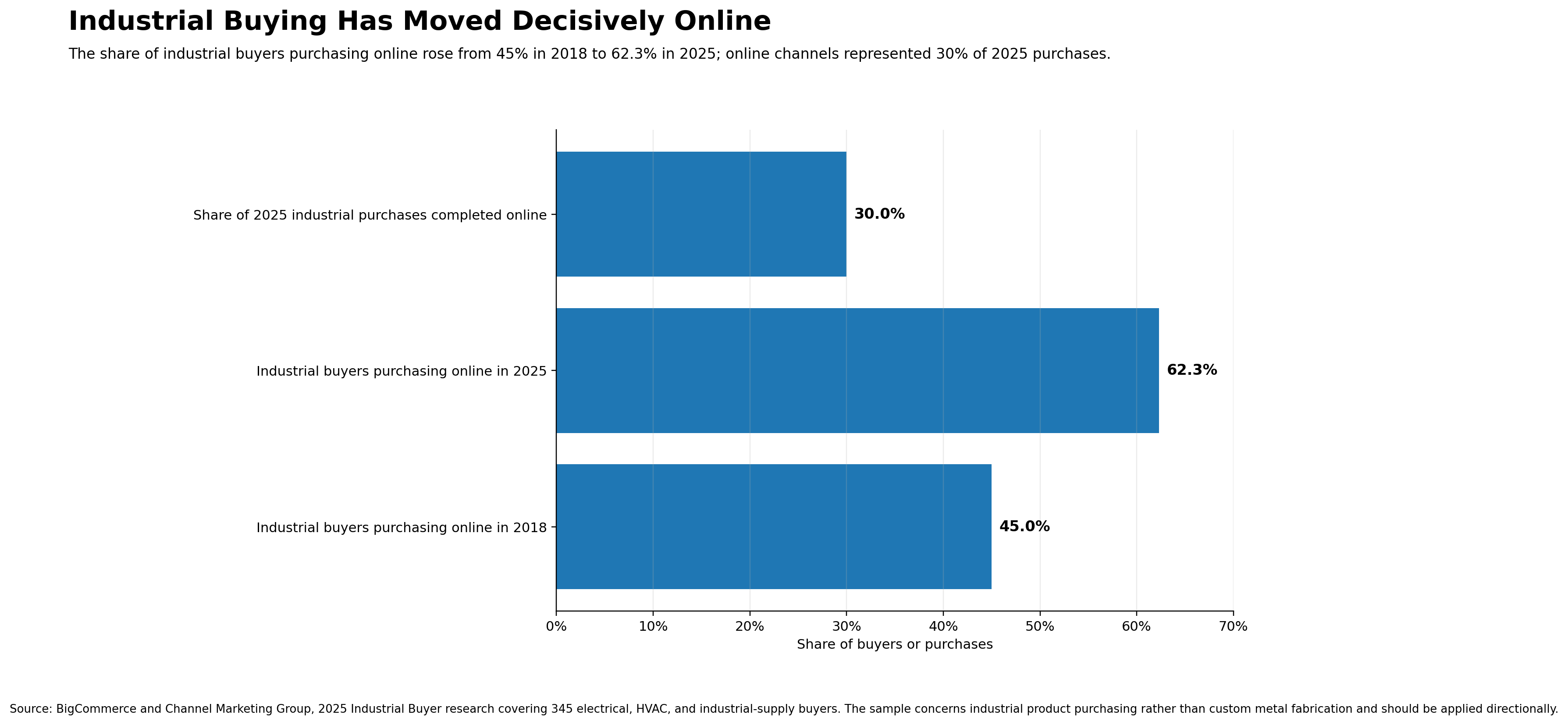
Industrial buying behavior has moved decisively online. In research covering electrical, HVAC, and industrial-supply buyers, the share purchasing online increased from 45% in 2018 to 62.3% in 2025; digital channels represented 30% of their purchases in 2025.
Most B2B buying decisions begin before direct seller contact. In 6sense’s 2025 research, 94% of buying groups ranked their shortlist before engaging sellers, and 95% of winning vendors were already on the buyer’s initial shortlist.
A lead-generating website must help buyers quickly determine the shop’s process fit, material fit, capacity, quality controls, project experience, geography, and commercial relevance.
Each priority capability, industry, material, and customer problem should have a useful, indexable page rather than being compressed into one generic “Services” page.
Project photographs, case studies, certifications, equipment information, named experts, and measurable performance evidence reduce perceived supplier risk.
Every serious visitor should have an appropriate conversion path: call, RFQ, drawing upload, consultation, text, NDA request, site visit, or capability review.
Website conversion is not complete when a form is submitted. The inquiry must be acknowledged, qualified, assigned, followed up, quoted, and connected to revenue.
Mobile performance deserves priority. Unbounce found that 83% of the landing-page visits in its dataset occurred on mobile devices, while desktop still converted 8% better—evidence of persistent mobile-conversion friction.
Google recommends good Core Web Vitals, including Largest Contentful Paint within 2.5 seconds, Interaction to Next Paint below 200 milliseconds, and Cumulative Layout Shift below 0.1.
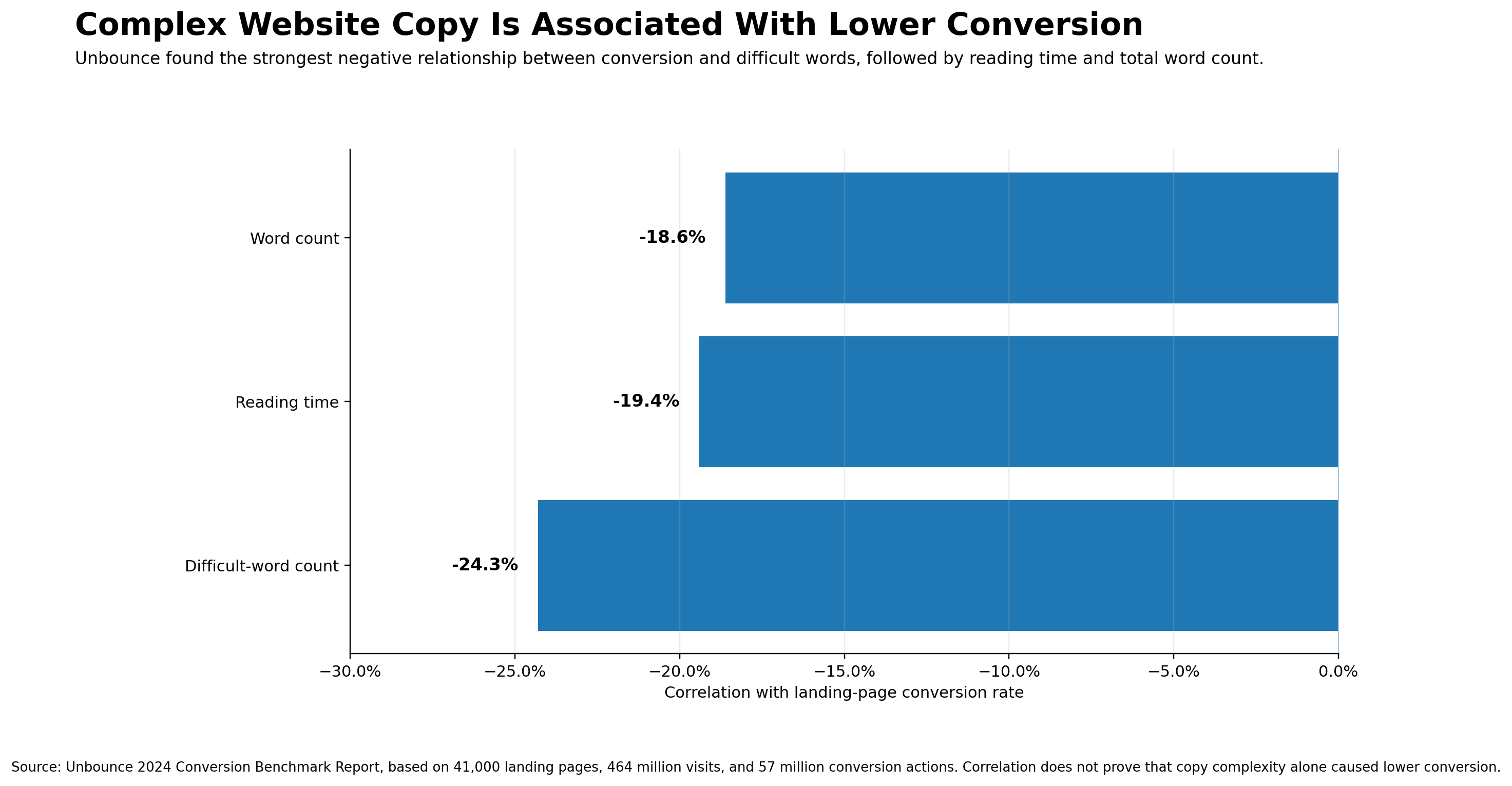
Clear language matters. Unbounce found negative correlations between conversion rates and difficult words, reading time, and total word count.
Google’s recent guidance for AI Overviews and AI Mode still emphasizes foundational SEO, crawlable technical structure, original expert-led content, high-quality media, and satisfying user experiences—not separate “AEO” or “GEO” tricks.
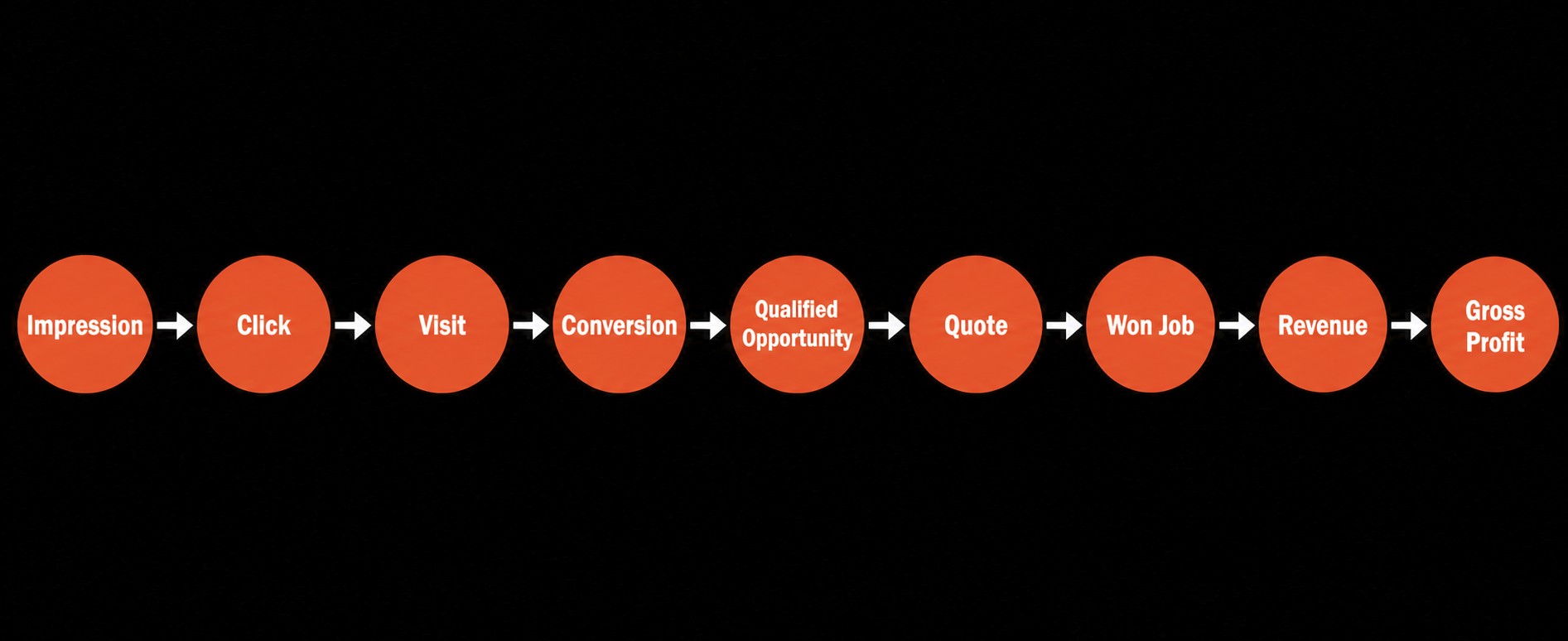
The most important website metrics are not raw traffic or form counts. Fabricators should track qualified RFQs, calls, appointments, quotes, wins, revenue, gross profit, and customer acquisition cost by source.
A modern metal fabrication website should help the business grow while the shop floor is busy producing work.
It should attract the right companies, explain what the shop does, eliminate poor-fit inquiries, answer common technical questions, demonstrate credibility, collect project information, schedule conversations, and tell management which marketing efforts produce profitable jobs.
Many fabrication websites do almost none of those things.
They contain a homepage, a short list of services, several stock photographs, a telephone number, and a general contact form. They may look respectable, but they leave the buyer to answer critical questions independently:
Does this company work with our material?
Can it support our dimensions and production volume?
Has it completed comparable work?
Does it possess the required certification?
Does it serve our location?
Can it provide finishing or installation?
Is it accepting new projects?
What does it need to prepare a quote?
Who will respond when we submit the request?
When those answers are unclear, the website creates friction rather than demand.
A lead-generating website takes the opposite approach. It anticipates the buyer’s evaluation process and turns each page into a deliberate step toward a commercially useful action.
Industrial Buyers Have Moved Online
Industrial companies can no longer assume that serious buyers prefer to conduct all research through telephone calls, sales representatives, printed line cards, or personal referrals.
Those channels remain important, but they now coexist with a digital buying environment.
BigCommerce and Channel Marketing Group surveyed 345 electrical, HVAC, and industrial-supply buyers in 2025 and compared the findings with a 2018 benchmark. The share purchasing online increased from 45% to 62.3%, while online channels accounted for approximately 30% of total purchases in 2025. The research concerns industrial products rather than custom fabrication, but it demonstrates how rapidly digital expectations are changing across industrial markets.
Digital Expectations Extend Beyond Ecommerce
A custom fabrication shop may not be able to offer one-click purchasing.
Projects may require:
Drawings
Site measurements
Material review
Engineering
Quantity analysis
Tolerance review
Installation planning
Quality documentation
Freight coordination
Contract review
That does not excuse a poor digital experience.
Industrial buyers increasingly expect websites to provide speed, convenience, technical clarity, mobile access, and self-service information even when the final transaction requires human review. BigCommerce’s 2026 industrial analysis argues that complicated products and long sales cycles no longer justify difficult online experiences.
Self-Service Does Not Mean Self-Quoting
For a custom metalworking company, useful self-service may include:
Viewing capabilities
Reviewing materials
Confirming geographic coverage
Checking certifications
Downloading a capability statement
Seeing relevant project examples
Understanding the quoting process
Uploading drawings
Requesting an NDA
Scheduling a technical review
Asking for a callback
The buyer can make meaningful progress without the website making unauthorized technical or commercial commitments.
The Website Influences the Shortlist Before Sales Is Contacted
The most important function of a modern website may occur before the company knows that a buyer exists.
The 2025 6sense Buyer Experience Report collected nearly 4,000 responses across several regions and industries, including manufacturing respondents. Buyers evaluated approximately five vendors, usually had previous experience with most of them, and ranked their shortlist before speaking with sellers. Ninety-five percent of winning vendors were already on the initial shortlist.
The buyer may use the website to evaluate:
Technical capability
Industry experience
Project relevance
Geographic fit
Quality maturity
Capacity
Business stability
Responsiveness
Ease of working together
Overall supplier risk
The Website Is a Pre-Sales Due-Diligence Room
A lead-generating fabrication website should enable an engineer, procurement manager, estimator, general contractor, architect, or plant manager to conduct meaningful due diligence.
The website does not need to disclose confidential information.
It does need to provide enough evidence for the buyer to answer:
Is this company sufficiently relevant and credible to contact?
First Contact Often Validates an Existing Preference
6sense found that buyers typically initiate seller contact themselves and overwhelmingly begin with the vendor they already prefer. The first contacted vendor wins approximately 80% of the time in the research.
The practical implication is significant:
A website should not be built only to generate a form submission. It should help the company become the buyer’s preferred option before that submission occurs.
The Systems Inside a Lead-Generating Website
A high-performing website is not one feature.
It is a connected operating system.
The systems are:
Attract qualified traffic.
Match the visitor's intent.
Prove technical fit.
Reduce perceived risk.
Offer the appropriate conversion path.
Capture complete project information.
Respond immediately.
Build for mobile, speed, and accessibility.
Write clearly enough to convert.
Build content for search, AI discovery, and human buyers.
Strengthen local and industrial discovery.
Nurture unfinished demand.
Connect activity to revenue.
Match the visitor’s intent.
Prove technical fit.
Reduce perceived risk.
Offer the appropriate conversion path.
Capture complete project information.
Respond immediately.
Nurture unfinished demand.
Connect activity to revenue.
Improve continuously.
A weakness in any one stage can suppress the performance of the entire system.
1. Attract the Right Traffic
Traffic is not automatically valuable.
A shop specializing in repeat stainless production assemblies may gain little from hundreds of monthly visitors looking for automotive exhaust repair.
A structural steel contractor may not benefit from national traffic for small decorative gifts.
Define the Commercial Search Market
Before building pages, define:
Priority services
Priority materials
Ideal project types
Minimum viable project
Production-volume range
Target industries
Service geography
Required certifications
Work the shop does not want
This prevents the website from attempting to attract everyone who types the word “metal” into Google.
Build Pages Around Commercially Meaningful Topics
Potential capability pages include:
Custom metal fabrication
Structural steel fabrication
Sheet metal fabrication
Laser cutting
Press-brake forming
MIG welding
TIG welding
Robotic welding
CNC machining
Tube bending
Powder coating
Field installation
Equipment repair
Prototyping
Repeat production
Potential industry pages include:
Food and beverage processing
Agriculture
Construction
Manufacturing
Material handling
Architectural and commercial property
Municipal projects
Energy
Transportation
Equipment manufacturing
Connect Search Intent to the Correct Page
A search for “stainless food-processing fabrication” should not lead to a generic homepage that discusses every service equally.
It should lead to a page that explains:
Relevant stainless grades
Sanitary or cleanable design experience
Welding and finishing
Material traceability
Inspection
Representative applications
Project evidence
The next step
This is message match: aligning what the visitor searched for with what the landing page immediately presents.
Unbounce recommends matching landing-page language to the message used in the advertisement or source that generated the visit.
2. Match the Visitor’s Intent Immediately
A visitor should not have to read several paragraphs to discover whether the company is relevant.
Use a Capability-First Opening
A strong opening states exactly:
What the shop does
Who it serves
Where it operates
What work is a good fit
What the visitor should do next
Weak Opening
Building quality relationships through superior craftsmanship.
Stronger Opening
Custom Stainless Fabrication for Food, Beverage, and Agricultural Manufacturers
Cutting, forming, TIG welding, finishing, assembly, and field installation for production equipment, guards, platforms, and process-related components across the Pacific Northwest.
The stronger version communicates a material, customer, process group, application, and market.
Create a Clear Information Hierarchy
The first screen should prioritize:
Primary value proposition
Ideal customer or application
Principal action
Credibility evidence
Secondary conversion option
A fabrication homepage should not require the visitor to navigate a cinematic animation before finding the company’s capabilities or telephone number.
Above-the-Fold Proof
Useful proof may include:
Years in business
Relevant certifications
Industries served
Project count
On-time-delivery performance
Primary service area
Current capacity statement
Named customer categories
Every numerical statement should be accurate, current, and supportable.
3. Prove Technical Fit
A buyer should be able to determine whether the company belongs on the sourcing list.
Thomas advises industrial suppliers to communicate company history, value propositions, key capabilities, certifications, equipment, production processes, images, PDFs, and video.
What a Capability Page Should Contain
Process
Explain:
What the shop performs
Which equipment is used
Whether the process is in-house
Suitable applications
Prototype and production availability
Related secondary operations
Materials
Identify supported materials, such as:
Carbon steel
Stainless steel
Aluminum
Galvanized steel
Copper
Brass
Specialty alloys
Do not list materials the company cannot reliably process.
Capacity and Boundaries
Where commercially appropriate, disclose:
Maximum part size
Maximum thickness
Press-brake length and tonnage
Table dimensions
Lifting capacity
Typical tolerance range
Suitable production quantities
Installation radius
Accepted drawing formats
Quality and Documentation
Include relevant information about:
Inspection
Calibration
Material traceability
Nonconformance procedures
Welding qualifications
Quality certifications
First-article inspection
Customer-specific documentation
Boundaries Can Improve Lead Quality
Some businesses hide minimums and limitations because they fear discouraging inquiries.
But a lead-generating website should discourage the wrong inquiries.
Appropriate boundaries can reduce:
Small jobs below minimum size
Work outside the service area
Materials the shop does not handle
Quantities outside the shop’s model
Projects requiring unavailable certifications
Unrealistic schedules
The objective is not the greatest number of leads.
It is the greatest number of commercially appropriate opportunities.
4. Reduce the Buyer’s Perceived Risk
The buyer is not only evaluating whether the shop can fabricate the part.
The buyer is assessing whether the shop can do so without creating unacceptable quality, schedule, communication, or commercial risk.
Use Project Evidence, Not Generic Claims
A project gallery should explain:
Customer industry
Project objective
Material
Processes
Quantity
Technical constraint
Quality requirement
Schedule challenge
Result
Weak Project Description
Custom fabricated frame completed for a local customer.
Stronger Project Description
Fabricated and powder-coated 36 repeat equipment frames for a regional material-handling manufacturer. The project combined laser cutting, CNC forming, fixture-controlled welding, inspection, coating, and final assembly through one managed production workflow.
The second description helps a buyer understand project relevance.
Build Case Studies Around Decisions
A case study should include:
The Situation
What was the customer trying to accomplish?
The Constraint
What made the work difficult?
The Approach
Which processes, people, and controls were used?
The Result
What changed for the customer?
The Qualification
Under what conditions was the outcome achieved?
Use Original Photography
Useful website photography includes:
Employees performing the work
Equipment
Fixtures
Inspection
Raw materials
Work in process
Finished products
Packaging
Loading
Installation
Google’s 2026 generative-search guidance recommends useful, high-quality images and video when they support the visitor’s experience.
Make Expertise Visible
Publish named biographies for:
Estimators
Project managers
Engineers
Quality Leaders
Certified Inspectors
Experienced Fabricators
Company Leadership
Google recommends clear authorship and first-hand expertise in content where readers would reasonably expect it.
5. Offer the Right Conversion Path
Not every visitor is prepared to submit a formal RFQ.
A website should offer several next steps without overwhelming the visitor.
Primary Conversion Paths
Request a quote
Upload drawings
Call
Schedule a consultation
Request a site visit
Ask a capabilities question
Request an NDA
Download a capability statement
Match the Action to the Buying Stage
Early Research
Offer:
Capability statement
Case study
Technical guide
Project gallery
Email update
Active Evaluation
Offer:
Capability review
Drawing review
Consultation
Project discussion
Plant tour
Quote Ready
Offer:
RFQ form
Drawing upload
Quantity and material submission
Bid invitation
Site-measurement request
Use Specific Calls to Action
“Contact Us” does not explain what happens next.
Stronger calls to action include:
Request a Drawing Review
Confirm Project Fit
Discuss Production Capacity
Upload Files for an RFQ
Schedule a Site Consultation
Request a Fabrication Quote
6. Capture Complete Project Information
The website should help the sales and estimating teams begin with useful context.
Recommended RFQ Fields
Name
Company
Telephone number
Email
Project description
Requested process
Material
Quantity
Dimensions
Project location
Desired completion date
Installation requirement
Drawing or file upload
Certification requirements
Preferred contact method
Balance Detail and Friction
A long form may improve qualification but reduce completion.
A short form may increase submissions but create more unqualified follow-up work.
One solution is progressive intake.
Step 1: Basic Information
Name
company
contact information
project category
Step 2: Project Information
Material
quantity
dimensions
location
schedule
Step 3: Files and Requirements
Drawings
Photos
Specifications
Certifications
NDA
Confirm What Happens After Submission
The confirmation page and email should explain:
That the request was received
Who will review it
When the buyer should expect acknowledgment
Whether missing information may be requested
That submission does not constitute quote acceptance
How urgent needs should be escalated
7. Respond Immediately
A website-generated lead can be lost after the form works perfectly.
Common failures include:
No confirmation
Form routed to an inactive employee
Drawing attachment blocked
Telephone call unanswered
Lead not entered into the CRM
No assigned owner
Delayed response
No follow-up after the first attempt
Use MW-Labs for Call Coverage and Scheduling
MW-Labs can help MetalWorks SEO clients:
Answer inbound calls
Classify caller intent
Collect fabrication-specific information
Schedule approved appointments
Send drawing-upload links
Route urgent requests
Document conversations
Create CRM records
It should not autonomously approve technical feasibility, pricing, capacity, lead time, engineering, safety, or contractual terms.
Establish Response Standards
Recommended internal measures include:
Call answer rate
RFQ acknowledgment time
Technical-review time
Quote turnaround
Percentage of leads assigned
Percentage of promised follow-ups completed
Unresolved-inquiry rate
These are management benchmarks rather than Google ranking factors.
8. Build for Mobile, Speed, and Accessibility
A buyer may visit the website:
From a jobsite
On a factory floor
During a meeting
From an email link
While traveling
Immediately after receiving a referral
Unbounce’s benchmark study found that 83% of analyzed landing-page visits came from mobile devices, yet desktop converted 8% better. The dataset spans many industries rather than fabrication specifically, but the gap demonstrates that mobile usability remains a material conversion issue.
Mobile Conversion Requirements
Clickable telephone number
Large buttons
Short navigation
Readable technical tables
Fast-loading images
Accessible forms
Simple file upload
Visible primary action
No intrusive popups
No horizontal scrolling
Meet Core Web Vitals Targets
Google recommends:
Largest Contentful Paint: 2.5 seconds or less
Interaction to Next Paint: below 200 milliseconds
Cumulative Layout Shift: below 0.1
Common Fabrication Website Performance Problems
Full-resolution project images
Large background videos
Uncompressed galleries
Excessive plugins
Third-party tracking scripts
Poor hosting
Unstable image dimensions
Unnecessary animation
Large downloadable PDFs loaded directly in pages
Accessibility Supports Conversion
Priority practices include:
Sufficient color contrast
Descriptive alt text
Proper form labels
keyboard navigation
visible focus states
clear validation errors
captioned video
logical heading structure
accessible PDFs
Accessibility should be reviewed through both automated and manual testing.
9. Write Clearly Enough to Convert
Industrial companies sometimes mistake complexity for authority.
The best technical communication is usually precise, not needlessly difficult.
Unbounce found negative correlations between conversion rates and difficult words, reading time, and total word count. It also reported that landing pages written at a fifth- to seventh-grade reading level converted at 11.1%, compared with 5.3% for professional-level language in its dataset. These results span many industries and do not mean all technical content should be simplified to the same level; they show the commercial cost of avoidable complexity.
Explain Technical Terms When Necessary
Technical language is appropriate when the buyer expects it.
Use:
Accepted industry terminology
Defined acronyms
Short paragraphs
Descriptive headings
Tables
Diagrams
Examples
Captions
Avoid:
Unnecessary corporate language
Long introductions before the answer
Repetitive keyword variations
Empty adjectives
Claims without evidence
Replace Marketing Generalities with Specific Information
Generic
We leverage cutting-edge solutions to provide world-class results.
Specific
Our in-house laser cutting, forming, welding, and powder-coating workflow gives qualified customers one accountable production path from raw sheet to finished assembly.
The specific version communicates an operational benefit.
10. Build Content for Search, AI Discovery, and Human Buyers
Search behavior is evolving through AI Overviews, AI Mode, large language models, and agentic tools.
The appropriate response is not to abandon SEO.
Google’s June 2026 guidance states that its generative-search experiences remain grounded in core Search ranking and quality systems. Google recommends foundational SEO, original non-commodity content, useful media, clear technical structure, crawlability, and a strong page experience. It says no special llms.txt file, “chunking” method, or AI-specific writing style is required for Google Search.
Publish Content Only the Shop Can Create Well
Examples include:
Project case studies
DFM lessons
Material-selection considerations
Tolerance-cost tradeoffs
Weld-distortion examples
Finishing failures
Installation planning
Quoting checklists
Inspection explainers
Shop-floor video
Equipment demonstrations
Project postmortems
Use “Who, How, and Why”
Google recommends making clear:
Who created the content
How it was produced
Why it exists
Avoid Scaled Commodity Content
Publishing hundreds of shallow location pages or generic AI-written articles can create more URLs without creating more value.
Google’s 2026 guidance advises creating distinctive, expert-led information rather than recycling what is already available or producing pages primarily to manipulate rankings.
11. Strengthen Local and Industrial Discovery
Many metal fabricators depend on both local demand and regional or national industrial sourcing.
Optimize the Google Business Profile
Google says local results are mainly determined by relevance, distance, and prominence. Complete and detailed business information helps Google understand the company and match it to relevant searches.
Maintain:
Accurate name
address
telephone number
hours
categories
services
website
service area
description
photographs
review responses
Create Real Location and Service-Area Pages
A useful location page can explain:
Services available
Industries in the area
Field-service radius
Delivery coverage
Local project examples
Contact information
Facility details
Do not create dozens of nearly identical city pages with only the location name changed.
Optimize Industrial Supplier Profiles
Thomas allows buyers to evaluate supplier capabilities, equipment, certifications, location, and validation status. Its supplier guidance encourages companies to add detailed information, original images, PDFs, and video.
Keep website and supplier-directory information consistent.
Add Accurate Structured Data
Google’s Organization and Local Business structured-data documentation explains how businesses can provide explicit administrative information such as name, logo, address, telephone number, and operating hours. Structured data can improve Google’s understanding and create eligibility for supported search features, but it does not guarantee a rich result or ranking.
12. Nurture Visitors Who Are Not Ready Today
A high-value industrial buyer may research suppliers months before an RFQ.
The website should provide ways to remain useful during that period.
Nurture Assets
Capability statement
Buyer checklist
Technical guide
Case study
Project video
Email updates
Open-house invitation
Plant tour
Webinar
New-capability announcement
Segment the Follow-Up
An architect should not receive the same content as an OEM purchasing manager.
Possible segments include:
General contractors
OEMs
Food processors
Plant managers
Architects
Property managers
Municipalities
Residential customers
Equipment manufacturers
Reconnect With Incomplete Opportunities
Lead-nurture workflows can support:
Unscheduled inquiries
abandoned RFQs
lost bids
delayed projects
dormant customers
previous customers with likely repeat needs
Communication should remain permission-conscious, relevant, and easy to stop.
13. Connect Website Activity to Revenue
A modern website should provide management information.
Traffic alone is insufficient.
Measure the Full Funnel
Impression → Click → Visit → Conversion → Qualified Opportunity → Quote → Won Job → Revenue → Gross Profit
Visibility Metrics
Search impressions
Website Clicks
Branded versus non-branded traffic
Google Business Profile interactions
Supplier-profile views
Target-account visits
Google Search Console provides metrics including impressions, clicks, average click-through rate, and average position.
Website Metrics
Engaged visits
Capability-page engagement
Case-study views
CTA clicks
Form starts
Form completions
Drawing uploads
Telephone calls
Scheduled consultations
Sales Metrics
Qualified opportunities
Quotes
Quote value
Win rate
Average won-job value
Sales-cycle length
Revenue
Gross profit
Operational Metrics
Response time
Call answer rate
Quote turnaround
Follow-up completion
Missed-call recovery
Lost-lead reason
Lost-bid reason
Use Revenue-Aware Attribution
The most important question is not:
Which channel produced the most leads?
It is:
Which channel produced the most qualified and profitable work?
A campaign producing 40 small, poor-fit inquiries may be less valuable than one producing three appropriate OEM opportunities.
The Mathematics of Website Growth
Website growth comes from several connected variables.
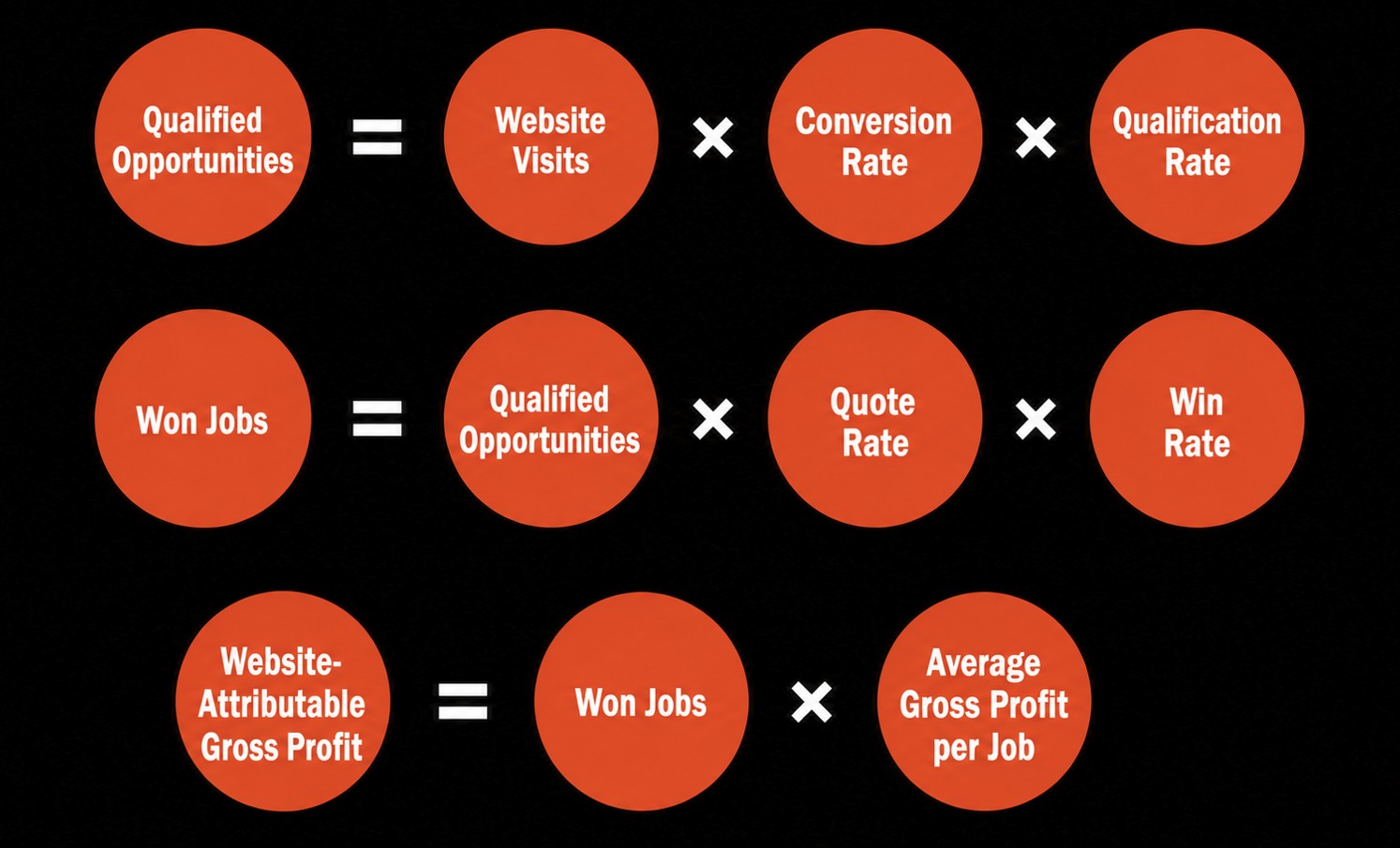
Qualified Opportunities = Website Visits × Conversion Rate × Qualification Rate
Won Jobs = Qualified Opportunities × Quote Rate × Win Rate
Website- Attributable Gross Profit = Won Jobs × Average Gross Profit per Job
Illustrative Example
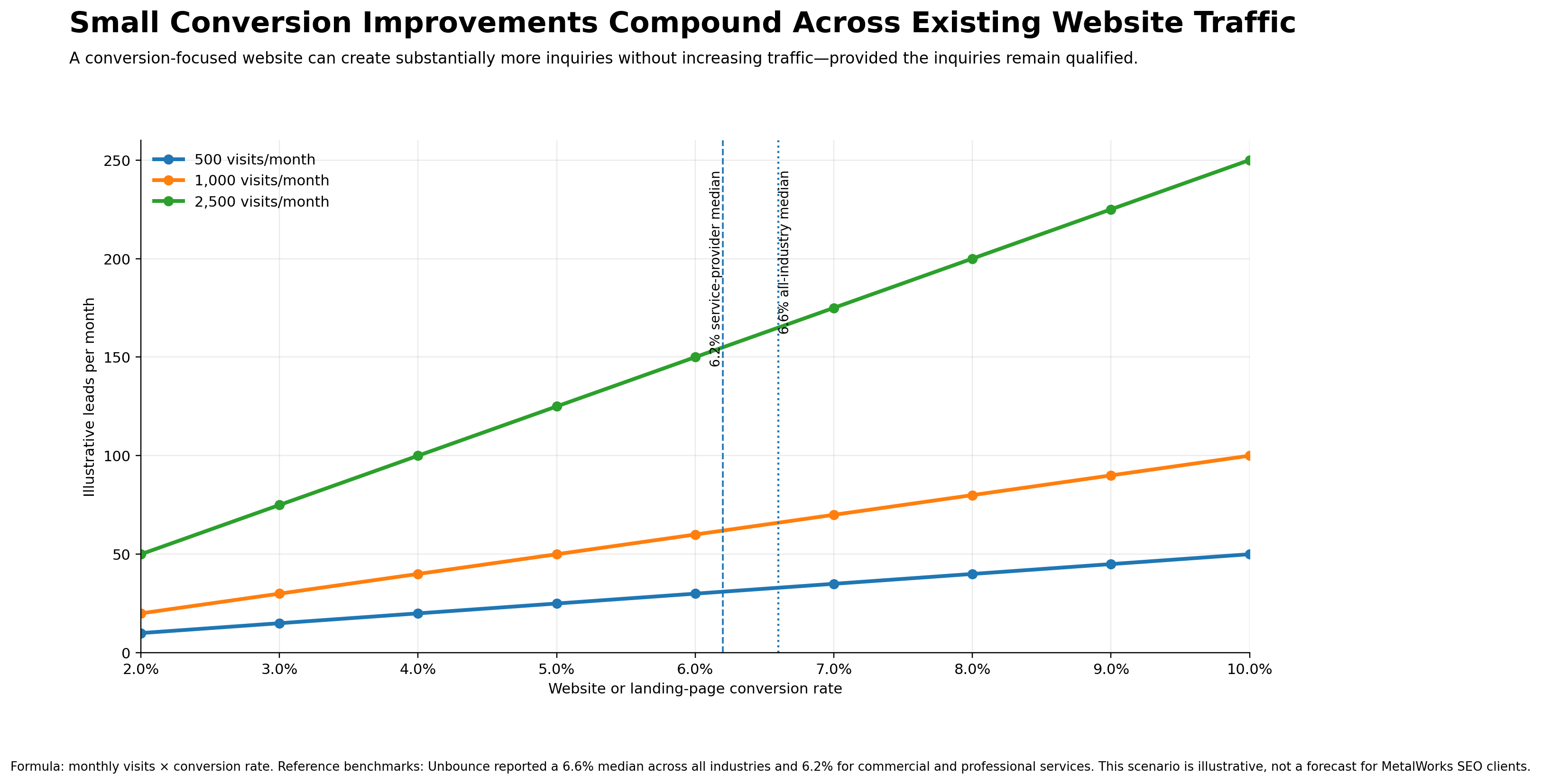
Assume a website receives 1,000 visits per month and converts 6.2% into inquiries—the median Unbounce reported for commercial and professional service providers. That would produce 62 inquiries.
If:
55% are qualified
70% receive a quote
30% of quotes are won
the model produces:
34 qualified opportunities
24 quotes
approximately seven won jobs
This is an illustrative calculation, not a forecast. Actual results depend on project type, traffic quality, pricing, capacity, qualification rules, market conditions, and sales execution.
Conversion Improvement Can Outperform Traffic Growth
A website with 1,000 monthly visits produces:
Conversion rate | Monthly inquiries |
|---|---|
2% | 20 |
4% | 40 |
6% | 60 |
8% | 80 |
10% | 100 |
Doubling conversion from 2% to 4% doubles the inquiry count without purchasing another visitor.
The business must still ensure that the additional inquiries are qualified and profitable.
A 30-Point Lead-Generating Website Audit
Strategy and Positioning
The ideal customer is defined.
Priority services and projects are clear.
The geographic market is stated.
The homepage explains why the company is different.
Poor-fit work is discouraged appropriately.
Search Architecture
Each priority capability has a dedicated page.
Important industries have useful pages.
URLs are descriptive.
Internal links connect related content.
Local and supplier profiles are complete.
Technical Proof
Materials are listed accurately.
Capacity and boundaries are described.
Certifications are current.
Equipment information is useful.
Quality and inspection procedures are visible.
Trust and Content
Original photography is used.
Case studies explain constraints and results.
Team expertise is visible.
Authors and reviewers are identified.
Claims can be substantiated.
Conversion
A primary CTA is visible.
Buyers can upload drawings.
Calls are clickable on mobile.
Multiple appropriate conversion paths exist.
Confirmation and follow-up are automated.
Performance and Measurement
Core Web Vitals are monitored.
Mobile forms are tested.
Calls and forms are tracked.
CRM stages connect leads to quotes and jobs.
Revenue and gross profit can be analyzed by source.
A 90-Day Website Growth Plan
Days 1–30: Diagnose
Audit Demand
Review:
Search visibility
Current traffic
Landing pages
Calls
Form submissions
Project fit
Lost inquiries
Existing CRM data
Interview the Team
Speak with:
Ownership
Sales
Estimating
Operations
Quality
Project Management
Identify:
Best work
Most profitable customers
Recurring buyer questions
Common disqualifiers
Reasons quotes are lost
Interview Customers
Ask:
How did you find the company?
What did you need to verify?
Which pages or materials helped?
What nearly prevented the inquiry?
Why did you choose the company?
Days 31–60: Build
Prioritize the Highest-Value Pages
Start with:
Homepage
Primary capability pages
Priority industry pages
RFQ page
Contact and location page
Case studies
Company and team pages
Build the Conversion System
Implement:
Drawing upload
Scheduling
Call tracking
MW-Labs
Confirmation
CRM routing
Source attribution
Improve Performance
Address:
Image size
Video
Hosting
Scripts
Mobile layout
From usability
Accessibility
Days 61–90: Launch and Optimize
Establish Baselines
Document:
Traffic
Conversion
Qualified inquiries
Calls
Appointments
Quotes
Wins
Revenue
Gross profit
Test High-Impact Changes
Potential tests include:
Headline
Primary CTA
Form length
Proof placement
Case-study placement
Telephone visibility
Mobile navigation
Consultation offer
Conduct Monthly Revenue Reviews
Review:
Which pages generated opportunities
Which keywords produced qualified visitors
Which calls were missed
Which RFQs became quotes
Which quotes became jobs
Which projects were profitable
Common Website Growth Mistakes
Mistake 1: Designing for the Owner Instead of the Buyer
Internal preferences should not override buyer clarity.
Mistake 2: Treating the Homepage as the Entire Website
Different services and industries require focused pages.
Mistake 3: Using Stock Photography as Proof
Buyers want evidence of the actual company and work.
Mistake 4: Optimizing for Traffic Instead of Fit
More irrelevant traffic creates administrative cost.
Mistake 5: Sending Every Visitor to One Generic Form
Different buyers need different next steps.
Mistake 6: Ignoring Calls
Telephone conversion is part of website conversion.
Mistake 7: Failing to Connect Leads to Revenue
Without closed-loop measurement, management cannot distinguish effective marketing from activity.
Mistake 8: Rebuilding Without Establishing Baselines
A new website cannot be evaluated when the previous performance was never measured.
Frequently Asked Questions
How Much Traffic Does a Metal Fabrication Website Need?
There is no universal threshold.
A specialized shop may grow from a relatively small number of highly qualified visits. Traffic should be evaluated alongside project fit, opportunity value, quote rate, win rate, and gross profit.
What Is a Good Website Conversion Rate?
Unbounce reported a 6.6% median across all industries and 6.2% for commercial and professional service providers. These are broad landing-page benchmarks, not metal-fabrication standards. A useful internal benchmark should distinguish qualified opportunities from all form submissions.
Should Every Fabricator Offer Online Quoting?
No. Online quoting may work for standardized products or tightly controlled services. Custom work often requires drawings, technical review, material pricing, capacity confirmation, and commercial analysis.
How Many Pages Should the Website Have?
Enough to explain each commercially important capability, industry, location, and buyer question without producing thin or repetitive content.
Google states that there is no preferred universal word count and recommends creating pages for visitors rather than manipulating search systems.
Does a Faster Website Automatically Rank Higher?
Google recommends good Core Web Vitals and an overall strong page experience, but no single speed metric guarantees ranking. Relevance, content quality, links, technical accessibility, competition, and many other factors also influence search performance.
Can AI-Generated Content Help a Fabrication Website?
AI can assist research, organization, editing, and production. The published result should still provide original expertise, accurate information, clear authorship, meaningful human review, and value beyond generic summaries. Google warns against large-scale automated content created primarily to manipulate rankings.
Does Structured Data Guarantee Better Rankings?
No. Organization, LocalBusiness, Article, and other relevant structured data can help Google understand content and create eligibility for supported search features. They do not guarantee indexing, rich results, or higher rankings.
Conclusion: Build a Website That Produces Commercial Progress
A modern fabrication website should not be judged by whether it looks newer than the previous website.
It should be judged by whether it helps the business:
Reach the right buyers
Enter more shortlists
Explain technical fit
Establish trust
Capture complete project information
Answer calls
Schedule conversations
Produce qualified RFQs
Accelerate quoting
Win profitable work
Understand which marketing investments create value
The best lead-generating website does not replace salespeople, estimators, engineers, or relationships.
It makes each of them more productive.
It allows buyers to complete basic research independently, gives the sales team better-qualified conversations, gives estimators more complete information, and gives management a clearer connection between digital activity and revenue.
That is the difference between a website that merely exists and a website that drives business growth.
Recommended MetalWorks SEO Call to Action
Is Your Website Producing Qualified Opportunities—or Merely Pageviews?
MetalWorks SEO helps metal fabrication companies build integrated customer-acquisition systems through:
Website strategy and development
Technical SEO
Capability and industry content
Conversion-focused RFQ architecture
Original case studies and project proof
MW-Labs inbound and outbound systems
Appointment scheduling
CRM integration
Call and form tracking
Revenue attribution
Request a Lead-Generation Website Audit
The audit can evaluate:
Search visibility
Positioning
Capability-page coverage
Technical proof
Mobile performance
Conversion paths
RFQ usability
Missed-call exposure
Response process
Analytics
Revenue attribution
---
Want to know where this is happening in your shop?
We'll run a free growth audit — your site, your local visibility, and how inquiries move from first contact to booked job. Thirty minutes, and the findings are yours either way.
