A metal fabrication website should do more than prove that your company exists. It should help an engineer, estimator, procurement manager, general contractor, or OEM determine—quickly and confidently—whether your shop can complete the work.
That decision often begins long before anyone calls.
The 2025 6sense B2B Buyer Experience Report found that buyers were already approximately 61% through their purchasing journey before first contacting a seller. Ninety-four percent had ranked their shortlist before that conversation, and the vendor preferred before contact ultimately won 77% of the time.
That makes your website part salesperson, part estimator, part technical library, and part trust-building system.
Key Takeaways
Every competitive metalworks website should include:
A capability-first message that immediately explains what the company makes, who it serves, and why it is qualified.
Detailed, searchable pages for each priority fabrication process, material, industry, and application.
Real project proof, certifications, equipment information, quality controls, and case studies.
A frictionless request-for-quote system with drawing uploads and always-on call coverage.
Fast, mobile-friendly, accessible pages that meet current Core Web Vitals benchmarks.
Local and regional search architecture aligned with the company’s actual service footprint.
B2B buyers frequently form vendor preferences before speaking with sales. The 6sense research covers general B2B purchasing and should be applied directionally rather than treated as a fabrication-only study.
1. A Capability-First Value Proposition
Many fabrication websites open with statements such as:
Quality craftsmanship you can trust.
The sentiment is positive, but it does not help a buyer determine whether the company can perform the work.
A stronger homepage immediately answers five questions:
What processes do you perform?
Which materials do you work with?
What types of customers or industries do you serve?
Where do you perform or deliver the work?
Why should a buyer consider you instead of another qualified shop?
What the Homepage Should Communicate Above the Fold
A strong opening section might read:
Precision Sheet Metal Fabrication for Pacific Northwest Manufacturers
Laser cutting, CNC forming, MIG and TIG welding, assembly, and finishing for stainless steel, aluminum, and carbon-steel components—from prototypes to repeat production.
That statement gives the visitor a process, market, material set, geography, and production range.
The supporting section can then add:
ISO or AWS certifications
Maximum material thicknesses
Bed and table dimensions
Prototype and production capacity
Typical turnaround range
Industries served
Primary service area
A visible “Request a Quote” button
A click-to-call telephone number
Thomasnet advises industrial suppliers to highlight their history, value propositions, key products, capabilities, certifications, equipment, production processes, images, and videos. Its guidance specifically notes that industrial buyers may be searching for suppliers that satisfy stringent certification requirements.
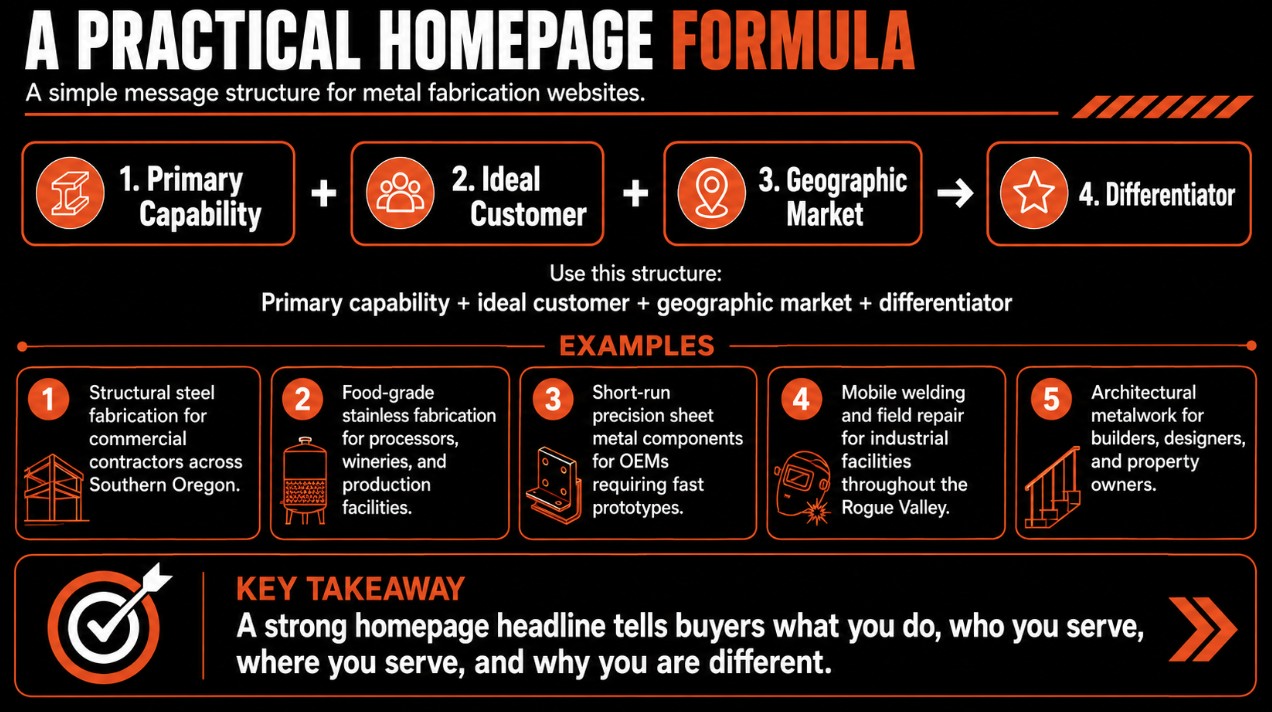
Structural steel fabrication for commercial contractors across Southern Oregon.
Food-grade stainless fabrication for processors, wineries, and production facilities.
Short-run precision sheet metal components for OEMs requiring fast prototypes.
Mobile welding and field repair for industrial facilities throughout the Rogue Valley.
Architectural metalwork for builders, designers, and property owners.
The Five-Second Fit Test
Show the homepage to someone unfamiliar with the company for five to ten seconds. Then ask:
What does this company make?
Who hires it?
Where does it operate?
What should a prospective customer do next?
This is a MetalWorks SEO usability benchmark, not a Google ranking factor. Its purpose is to eliminate ambiguity before a high-value buyer leaves the page.
2. Detailed Technical Capability Pages
A homepage cannot rank effectively for every process, material, application, and customer need—and it should not try.
A fabricator offering laser cutting, welding, forming, machining, powder coating, assembly, and field installation should generally build a dedicated page for each commercially important service.
Build One Searchable Page for Each Priority Capability
A fabrication website might include pages for:
Custom metal fabrication
Structural steel fabrication
Sheet metal fabrication
MIG welding
TIG welding
Robotic welding
CNC laser cutting
Plasma cutting
Waterjet cutting
CNC press-brake forming
Machining
Tube bending
Powder coating
Metal finishing
Prototyping
Production runs
Field welding
Repair and modification
Google recommends organizing websites logically, grouping topically related pages, using descriptive URLs, and creating content that is unique, useful, current, and written for people rather than search engines.
A URL such as:
/capabilities/laser-cutting/
is more useful to people and search engines than:
/services/page-4/
What Every Capability Page Should Include
Each page should answer the technical questions a buyer would normally ask an estimator.
Process Information
Explain:
How the process works
What equipment is used
What types of work are a good fit
What the process is not suited for
Available secondary operations
Prototype and production availability
Material Information
List relevant materials, such as:
Mild steel
Carbon steel
Stainless steel
Aluminum
Galvanized steel
Copper
Brass
Tool steel
Specialty alloys
Only list materials the shop can process – other products and services can be customized directly with a customer after proper expectations are set with them.
Capacity and Constraint Information
Include useful boundaries wherever disclosure is commercially appropriate:
Maximum sheet or plate size
Maximum cutting thickness
Press-brake length and tonnage
Tube or pipe diameter range
Welding processes
Tolerance ranges
Lifting or handling capacity
Production-volume range
Available finishing options
Buyer-Focused Applications
Explain what the capability produces:
Brackets
Frames
Enclosures
Guards
Platforms
Railings
Tanks
Hoppers
Skids
Machine bases
Architectural components
Production assemblies
Frequently Asked Questions
Good questions may include:
Which drawing formats do you accept?
Can you work from a physical sample?
Do you provide design-for-manufacturability feedback?
Can you source material?
Do you handle finishing and assembly?
What information is required for a quote?
Can you sign an NDA?
Do you provide installation?
What quantities are a good fit?
Avoid Thin “City + Service” Pages
Do not duplicate the same paragraph across dozens of city pages and change only the location name.
Google explicitly recommends unique, expert-led, non-commodity content and cautions against producing large volumes of automated material without adding meaningful value. Its current guidance for generative search also emphasizes foundational SEO, clear technical structure, high-quality media, and useful original content rather than “AEO” or “GEO” tricks.
Buyers began contacting sellers somewhat earlier in 2025, but most independent research still occurred before the first seller conversation.
3. Proof That Reduces the Buyer’s Perceived Risk
Fabrication buyers are not only purchasing a part. They are accepting several forms of risk:
Dimensional risk
Material risk
Schedule risk
Quality risk
Capacity risk
Safety risk
Communication risk
Supply-chain risk
Reputation risk
Your website should help reduce those concerns before the buyer submits an RFQ.
Replace the Generic Gallery with Documented Project Proof
A photograph of a welded frame may look impressive, but it provides limited decision-making value without context.
A stronger project entry includes:
Customer industry
Business problem
Material and grade
Fabrication processes
Dimensions or production quantity
Important tolerances
Surface finish
Schedule constraint
Quality-control process
Result
Weak Project Caption
Custom stainless project completed for a customer.
Strong Project Caption
Fabricated 304 stainless equipment guards for a regional food processor using laser cutting, CNC forming, TIG welding, passivation, and final assembly. The project required smooth, cleanable surfaces and repeatable fit across 24 production-line assemblies.
This communicates far more expertise without revealing confidential customer information.
Create Case Studies Around Business Outcomes
A useful case study can follow this format:
The Challenge
What technical, schedule, sourcing, or operational problem did the customer face?
The Fabrication Approach
What materials, processes, equipment, and quality procedures were used?
The Constraint
What made the project difficult?
Examples include:
Accelerated deadline
Tight tolerance
Low-volume prototype
Complex geometry
Food-grade finish
Field-fit requirement
High repeatability
Difficult material
Obsolete replacement component
The Result
What improved?
Possible outcomes include:
Shorter lead time
Reduced assembly labor
Lower component count
Improved serviceability
Better repeatability
Less material waste
Faster field installation
Reduced downtime
Do not manufacture numbers. Use measured results, customer-approved estimates, or qualitative outcomes when exact data is unavailable.
Show the Systems Behind the Craftsmanship
Trust pages should also include:
Current certifications
Welding qualifications
Quality-control procedures
Inspection equipment
Equipment list
Facility images
Team biographies
Safety practices
Industries served
Supplier registrations
Professional memberships
Warranty or workmanship policies
Testimonials attributed to real customers, when permitted
Google recommends clear authorship and background information that helps visitors understand who created the content and why that person or organization is qualified.
Use Original Photography
Show:
The shop floor
Fabricators at work
Welding cells
Cutting equipment
Press brakes
Inspection processes
Raw materials
Finished assemblies
Loading and shipping
Field installation
Google recommends placing clear, high-quality images near relevant text and using descriptive alternative text that explains the image’s relationship to the page.
4. A Frictionless RFQ System and Always-On Response
A website has not succeeded merely because it generated a visit. It must provide a sensible next step.
For most custom fabricators, that step is not “Buy Now.” It is a structured request for quote.
What a Fabrication RFQ Form Should Collect
The form should request enough information to qualify the project without creating unnecessary friction.
Recommended fields include:
Name
Company
Email
Telephone number
Project description
Requested process
Material
Quantity
Desired completion date
Delivery or service location
Drawing or file upload
Preferred contact method
Optional fields may include:
Material grade
Thickness
Tolerance requirements
Finish
Certification requirements
Inspection requirements
Repeat-production potential
NDA request
Accepted uploads might include:
PDF
DXF
DWG
STEP
STP
IGES
SolidWorks files
Photographs
Existing specifications
File types should be confirmed with the client’s estimator and cybersecurity provider.
Give Buyers More Than One Conversion Path
A visitor should be able to:
Submit an RFQ
Upload a drawing
Call
Text
Email
Schedule a project review
Request an NDA
Ask a preliminary capabilities question
Different buyers prefer different levels of commitment. An engineer researching five suppliers may not yet be ready to complete a long form, but may be willing to ask whether the shop can process a particular material or meet a certain tolerance.
Build for Always-On Call Coverage
Calls may arrive while the owner is welding, driving, meeting with a customer, operating equipment, or working in a noisy facility.
CallRail reported in 2025 that approximately 28% of calls to businesses went unanswered in its data. Because this figure comes from CallRail’s customer and beta-program data, it should not be treated as a universal rate for every fabrication company—but it demonstrates the scale of the missed-call problem.
A 24/7 response system—such as an Always-On Call Desk, Call Capture System, or Virtual Front Desk—can:
Answer common questions
Collect caller details
Identify the requested service
Determine whether the need is urgent
Capture project location
Schedule a consultation
Route priority calls
Send an immediate text confirmation
Create a CRM record
Notify the appropriate employee
Do Not Pretend Automation Is a Human Employee
The call flow should be transparent, accurate, and bounded by approved information.
It should not:
Invent pricing
Promise lead times
Confirm technical feasibility
Provide engineering advice
Commit to tolerances
Accept contractual terms
Misrepresent certifications
Claim that a quote has been approved
A professionally configured system should escalate technical, legal, safety, and high-value questions to a qualified person.
Design for Failover, Not Just Automation
The goal may be 100% call coverage, but responsible implementation requires:
Overflow routing
Voicemail backup
Call logs
Downtime alerts
Human escalation
Regular call-flow testing
Approved scripts
CRM synchronization
Privacy and recording disclosures where required
5. Speed, Mobile Usability, and Accessibility
Fabrication websites often contain large shop photographs, background videos, equipment galleries, CAD illustrations, and downloadable PDFs. Those assets can build trust, but they can also slow the website and make it harder to use.
Google’s current Core Web Vitals guidance recommends:
Largest Contentful Paint: within 2.5 seconds
Interaction to Next Paint: under 200 milliseconds
Cumulative Layout Shift: under 0.1
Google describes these as measures of loading performance, responsiveness, and visual stability, and recommends achieving good Core Web Vitals for both search success and user experience.
Practical Performance Improvements
A fabricator should consider:
Converting photographs to modern image formats
Serving properly sized images
Compressing video
Avoiding autoplay background video on mobile
Limiting unnecessary plugins
Removing unused scripts
Using browser and server caching
Improving hosting
Loading nonessential media later
Reserving image dimensions to prevent layout movement
Testing important pages with PageSpeed Insights and Search Console
Design for the Buyer Standing on a Jobsite
Mobile visitors may be:
On a construction site
In a plant
Walking a shop floor
Comparing suppliers during a meeting
Opening a link from an email
Attempting to call with one hand
The mobile website should provide:
Large tap targets
Click-to-call functionality
A short navigation menu
Readable technical tables
Fast-loading images
Simple forms
Persistent access to the RFQ page
Easily downloadable capability documents
Accessibility Is Also a Quality-Control Issue
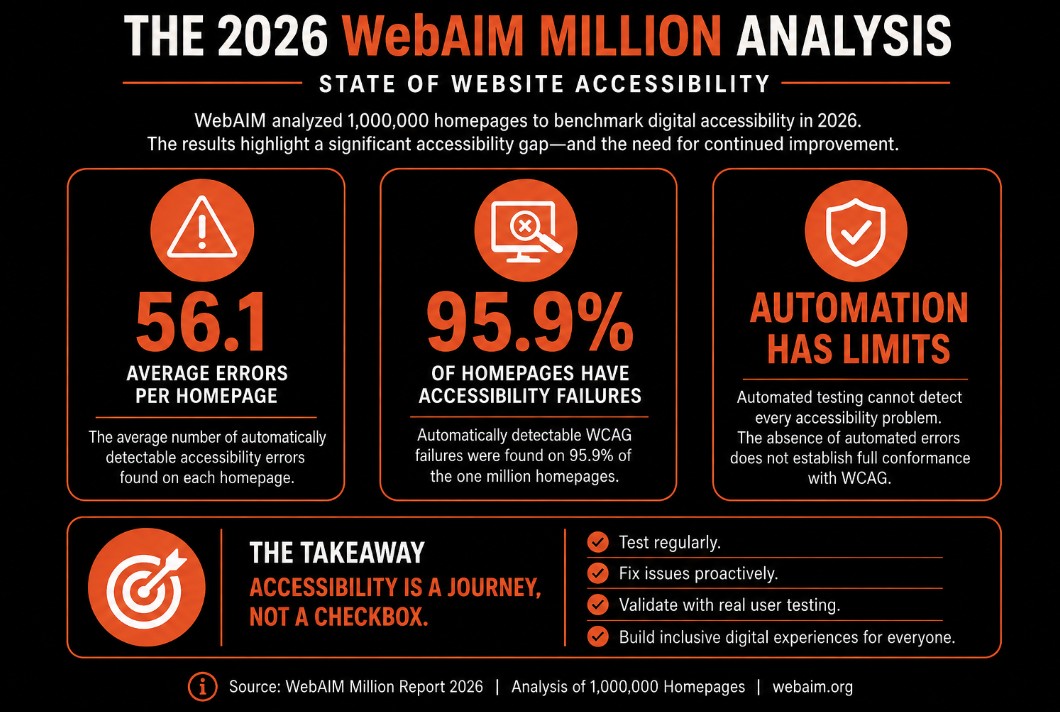
The 2026 WebAIM Million website analysis detected an average of 56.1 accessibility errors per homepage across the one million pages studied. It found automatically detectable WCAG failures on 95.9% of homepages. WebAIM also notes that automated testing cannot detect every accessibility problem, so the absence of automated errors does not establish full conformance.
Priority Accessibility Checks
Start with:
Sufficient text contrast
Descriptive image alt text
Properly labeled form fields
Clear error messages
Descriptive link text
Functional keyboard navigation
Visible keyboard focus
Meaningful button labels
Captions for important video
Proper heading structure
Declared document language
Accessible PDFs
Low contrast, missing alt text, unlabeled forms, empty links, and empty buttons remain widespread. *
6. Local and Service-Area SEO Architecture
Many fabricators serve multiple markets at once.
A company may perform:
Local repair work within 30 miles
Structural fabrication across the state
Production manufacturing throughout the West Coast
Shippable component work nationwide
The website should make those distinctions clear.
Build Location Strategy Around Real Operations
Useful geographic pages might cover:
A staffed fabrication facility
A legitimate branch
A metropolitan service area
A region with meaningful project experience
A state in which the company regularly operates
A market with distinctive industries or compliance requirements
Each location page should provide unique information, such as:
Capabilities offered in that market
Relevant industries
Delivery or field-service limitations
Representative projects
Local regulations or project requirements
Travel radius
Facility details
Contact information
Customer questions specific to the area
Align Website w ith the Google Business Profile (GBP)
Google says local results are primarily based on relevance, distance, and prominence. It advises businesses to verify their profiles, keep information complete and accurate, respond to reviews, and add photos and videos. Google also notes that links, reviews, and positive ratings can contribute to local prominence.
Important information should remain consistent across:
Website
Google Business Profile
Bing Places
Industry directories
Chamber listings
Supplier profiles
Social profiles
Trade organizations
Review:
Legal and public business name
Address
Telephone number
Hours
Website address
Primary business category
Secondary categories
Service area
Business description
Photographs
Review responses
Use Structured Data Accurately
Organization and LocalBusiness structured data can provide explicit information about the company, including its name, logo, address, contact details, and business hours. Google explains that structured data helps its systems understand and classify page content.
Appropriate markup may include:
Organization
LocalBusiness
Service
Article
BreadcrumbList
VideoObject
Person or ProfilePage for genuine authors
Structured data must match visible page content. It should not be used to create fake reviews, irrelevant classifications, misleading locations, or unsupported claims. Correct markup can make a page eligible for certain search features, but Google does not guarantee that a rich result will appear.
Connect Industrial Directory Profiles
A Thomasnet profile or comparable industrial directory listing should align with the company website’s capabilities, certifications, description, imagery, and contact information.
Thomasnet’s profile guidance recommends uploading images, PDFs, and videos of products, equipment, and production processes and ensuring the business can receive buyer RFIs.
7. Measurement Connected to Quotes, Jobs, and Revenue
Traffic alone does not tell a fabricator whether marketing is working.
A website with 500 monthly visits and ten qualified RFQs may be more valuable than one with 5,000 visits and two irrelevant inquiries.
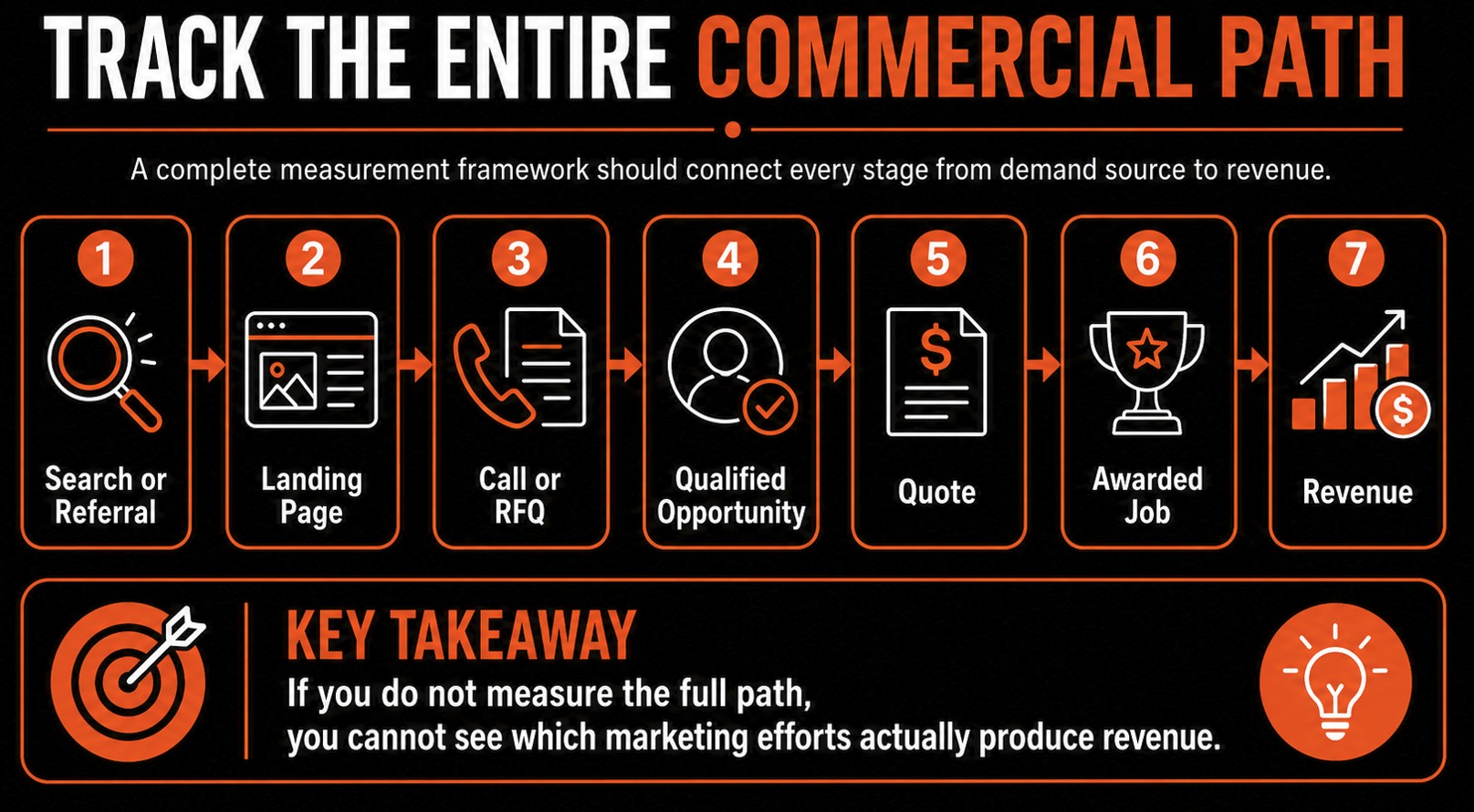
Track the Entire Commercial Path
A complete measurement framework should connect:
Search or referral → landing page → call or RFQ → qualified opportunity → quote → awarded job → revenue
Recommended systems include:
Google Search Console
Web analytics
Call tracking
Form tracking
CRM
Estimating or quoting software
Job-management system
Revenue records
Google recommends Search Console for monitoring how a site is discovered and performs in search. It also advises site owners to measure real-world page performance rather than relying only on assumptions or design appearance.
Report Metrics That Matter to the Business
Visibility Metrics
Search impressions
Non-branded search clicks
Priority keyword visibility
Google Business Profile interactions
Organic landing-page traffic
Referral traffic from industrial directories
Lead Metrics
Telephone calls
Answered-call rate
Missed calls
RFQ submissions
Drawing uploads
Scheduled consultations
Qualified-opportunity rate
Spam or irrelevant inquiry rate
Sales Metrics
Quotes issued
RFQ-to-quote rate
Quote-to-win rate
Average quoted value
Average awarded-job value
Sales-cycle length
Revenue by source
Gross profit by source, where available
Operational Metrics
Average response time
Time from RFQ to quote
Call escalation rate
Follow-up completion
Lost-lead reason
Lost-quote reason
Capacity-constrained opportunities
Use Attribution as a Decision Tool
A fabricator should be able to answer:
Which services generate the most qualified RFQs?
Which markets produce the highest-value work?
Which pages influence calls?
Which campaigns generate jobs rather than clicks?
Which calls go unanswered?
Which project categories have the highest win rate?
Which leads do not fit the shop’s capabilities?
Where does the quoting process slow down?
Which source produces the best gross profit?
Perfect attribution is rarely possible. The objective is a sufficiently reliable system for making better decisions.
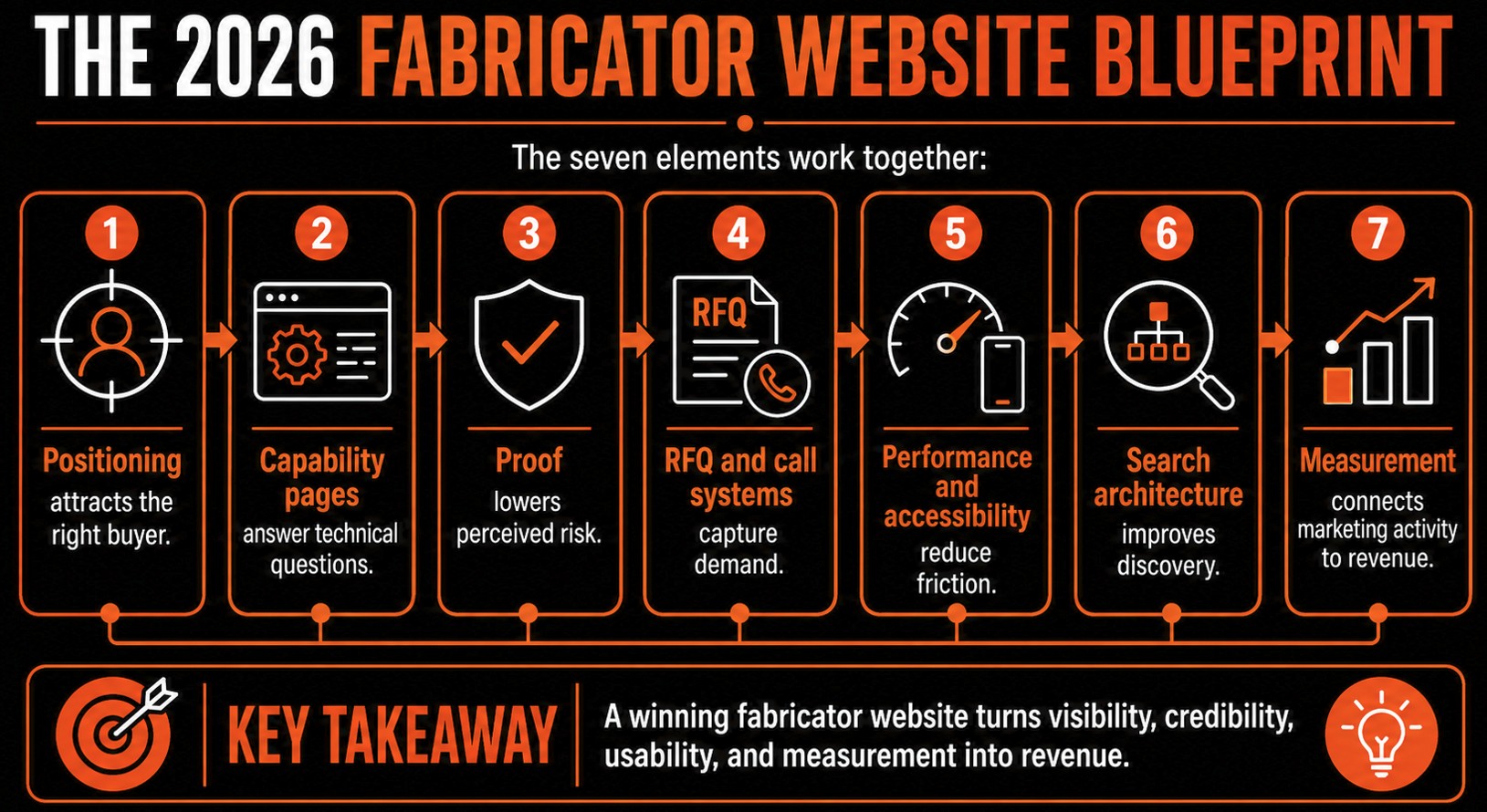
The 2026 Fabricator Website Blueprint
The seven elements work together:
Positioning attracts the right buyer.
Capability pages answer technical questions.
Proof lowers perceived risk.
RFQ and call systems capture demand.
Performance and accessibility reduce friction.
Search architecture improves discovery.
Measurement connects marketing activity to revenue.
Removing any one of these weakens the system.
A technically strong website with no proof may fail to earn trust. A beautiful website with no dedicated capability pages may remain invisible for commercially valuable searches. A high-ranking website with unanswered calls may send paid-for demand to a competitor.
A 25-Point Metalworks Website Audit
Use this initial audit to identify the most important gaps.
Positioning and Navigation
The homepage states the principal capabilities.
The ideal customer or industry is clear.
The geographic market is clear.
A buyer can reach every major service within two or three clicks.
The main navigation includes a visible RFQ action.
Technical Content and Proof
Every priority capability has a dedicated page.
Materials, equipment, capacity, and constraints are described accurately.
Certifications are current and verifiable.
Real project photography is used.
Case studies include technical context and outcomes.
Lead Capture
The RFQ form accepts relevant file types.
Required fields are limited to necessary information.
The telephone number is clickable on mobile.
After-hours and overflow calls are captured.
Every inquiry creates a trackable record.
Performance and Accessibility
Core Web Vitals are reviewed.
Images and video are optimized.
Form fields have visible labels.
Important images have descriptive alt text.
Keyboard and mobile usability are tested.
Search and Measurement
Google Business Profile information is complete and accurate.
Location pages represent genuine operations or service areas.
Organization and relevant structured data are implemented accurately.
Search Console, analytics, forms, and calls are connected.
Quotes, awarded projects, and revenue can be traced back to lead source.
Frequently Asked Questions
How many pages should a metal fabrication website have?
There is no ideal page count. Google specifically states that there is no magical minimum or maximum content length, and the same principle applies to arbitrary page-count targets. Build enough pages to explain each commercially meaningful capability, industry, material, location, and buyer question without creating repetitive or low-value content.
Should fabricators publish pricing on their websites?
Custom fabrication rarely supports universal pricing because cost depends on material, quantity, geometry, tolerances, finishing, inspection, programming, setup, freight, and schedule.
A company can still reduce uncertainty by explaining:
Minimum-order policies
Typical project sizes
Prototype availability
Material sourcing
Expedited-work policies
What is required for an accurate quote
Whether design support is billed separately
Should a fabrication company use an automated call-answering service?
It can be useful when the company lacks continuous front-office coverage, receives calls after hours, or routinely misses inquiries while employees are working in the shop.
The system should use approved information, disclose automation appropriately, route technical questions to qualified employees, and avoid making unsupported pricing, engineering, capacity, or scheduling commitments.
Does adding more keywords improve rankings?
Not by itself. Google cautions against keyword stuffing and recommends natural, useful content that anticipates the different terms knowledgeable and less-experienced searchers may use.
Is E-E-A-T a direct Google ranking factor?
No. Google explicitly states that E-E-A-T itself is not a specific ranking factor. It is a framework for understanding qualities such as experience, expertise, authority, and trust that Google’s systems may seek to identify through multiple signals.
Conclusion: Build a Sales Asset, not a Digital Brochure
The best metalworks websites in 2026 will not be the ones with the most animations, the largest keyword list, or the most generic blog posts.
They will be the websites that help real buyers make a lower-risk decision.
That requires:
Technical specificity
Verifiable proof
Original industry knowledge
Fast and accessible pages
Easy communication
Immediate response
Accurate local and entity information
Measurement tied to revenue
A website built around those principles becomes more than a marketing expense. It becomes a durable sales and customer-acquisition asset.
Request a Metalworks Website Opportunity Audit
Receive a prioritized review of your search visibility, capability pages, technical performance, buyer trust signals, and Google Business Profile.
---
Want to know where this is happening in your shop?
We'll run a free growth audit — your site, your local visibility, and how inquiries move from first contact to booked job. Thirty minutes, and the findings are yours either way.