How Buyers Actually Choose a Metalworks Contractor
Key Takeaways
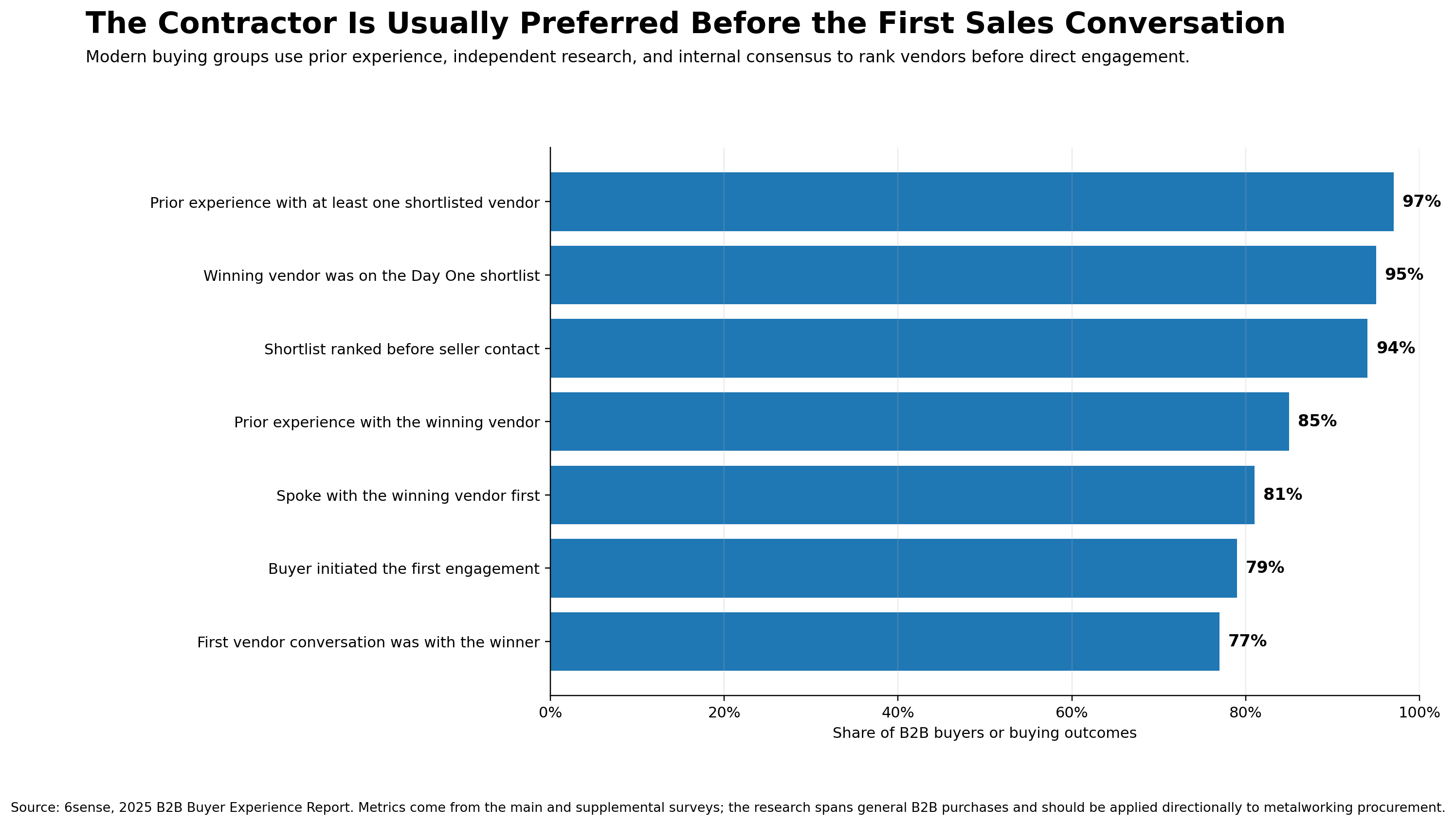
• Buyers rarely begin with a blank slate. In 2025 B2B research, 97% had previous experience with at least one shortlisted vendor, and 85% had prior experience with the company that ultimately won.
• Ninety-five percent of winning vendors were already on the buyer’s Day One shortlist. Being visible and credible before an active RFQ appears is therefore critical.
• Buyers generally follow two broad phases: selection before direct contact and validation after contact.
• Technical capability qualifies a metalworks contractor, but buyers also evaluate quality, delivery, price, capacity, communication, compliance, continuity, and overall risk.
• A low bid can lose when it contains ambiguous assumptions, unproven lead times, weak quality evidence, or greater downstream risk.
• Responsiveness acts as a preview of project execution. Unanswered calls, slow RFQ acknowledgment, vague answers, and inconsistent follow-up can remove a technically qualified contractor from consideration.
• Certifications help buyers narrow the field, but documentation, project proof, references, inspection practices, and credible people convert credentials into trust.
• Different stakeholders evaluate different forms of risk. Engineers, procurement teams, quality managers, project managers, finance leaders, and executives may each influence the final decision.
• Metalworking companies should design their websites, directory profiles, case studies, RFQ systems, and sales processes to win a place on the shortlist—not merely generate anonymous traffic.
• The strongest contractor is often not the cheapest or largest. It is the supplier the buying group believes can deliver the required result with the least unacceptable risk.
________________________________________
Most metal fabrication companies imagine contractor selection beginning when an RFQ arrives.
By then, much of the decision may already have been made.
A buyer may have searched Google, consulted a colleague, reviewed Thomasnet profiles, revisited a former supplier, examined project photographs, checked certifications, compared service pages, read reviews, and formed an internal preference before anyone at the fabrication company knows an opportunity exists.
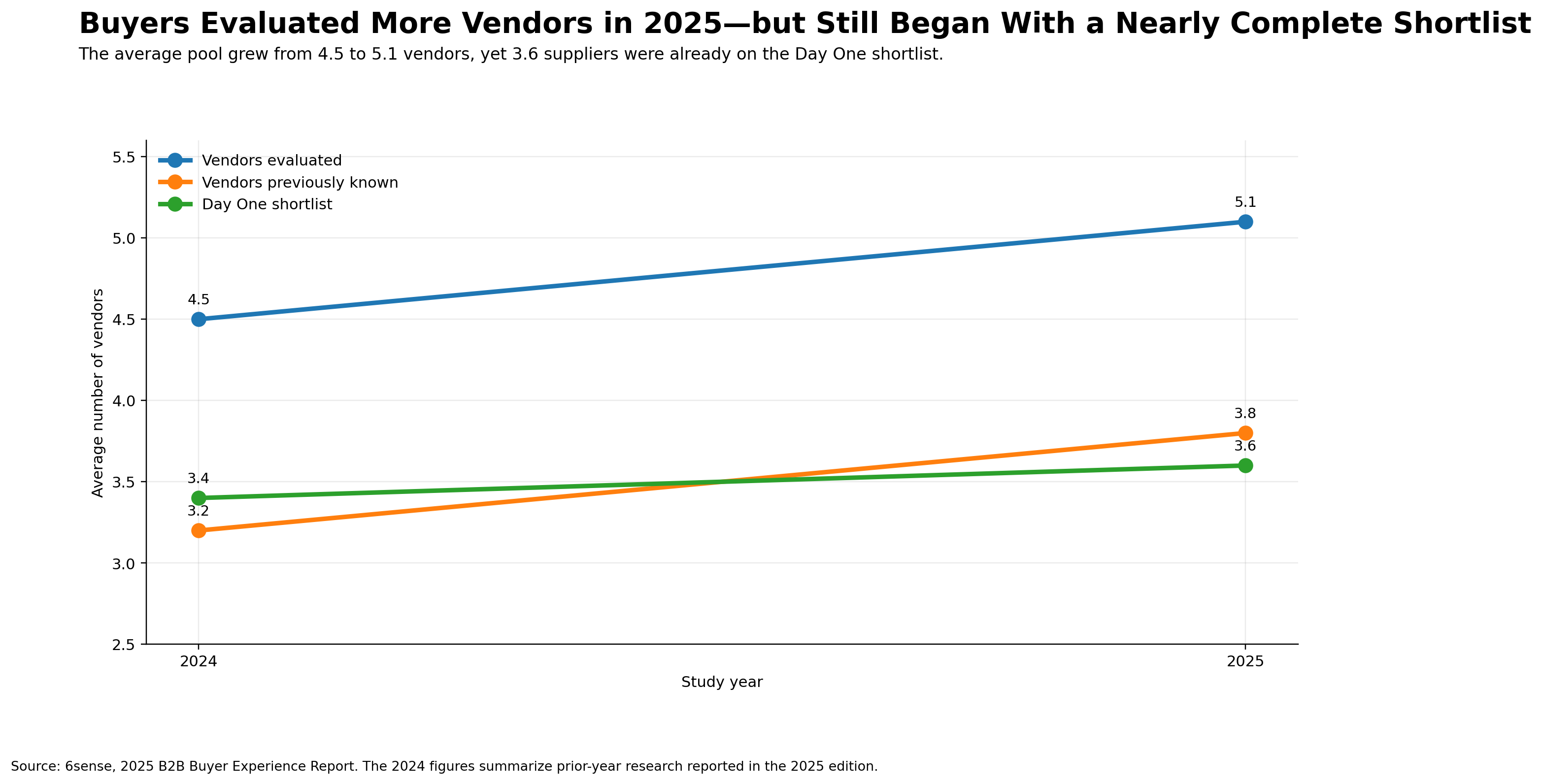
The 2025 6sense B2B Buyer Experience Report found that buyers evaluated an average of 5.1 vendors, had prior experience with 3.8 of them, and placed 3.6 on their shortlist at the beginning of the journey. The eventual winner came from that Day One shortlist 95% of the time. Although the research covers broader B2B purchases rather than metal fabrication alone, it provides a useful directional picture of how experienced industrial buying groups behave.
That changes the central marketing question.
It is not merely:
How do we respond when someone requests a quote?
It is:
How do we become one of the few contractors a buyer already trusts enough to contact?
Contractor Selection Is a Risk-Management Decision
A buyer is not simply purchasing fabricated metal.
The buyer may also be accepting responsibility for:
Whether the component fits
Whether the weld meets specification
Whether the material is traceable
Whether production begins on schedule
Whether an installation crew is delayed
Whether a line remains operational
Whether a customer delivery is missed
Whether the supplier can handle future volume
Whether the quote includes the complete scope
Whether a quality or safety problem becomes the buyer’s problem
CIPS defines supplier appraisal as evaluating a supplier’s ability to carry out a contract in terms of quality, delivery, price, and other contributing factors. Its supplier-relationship guidance also emphasizes assessing contractual capability, measuring performance, identifying challenges, and maintaining appropriate communication.
This is why contractor selection is more complicated than comparing three totals at the bottom of three quotes.
A metalworks buyer is making an imperfect prediction:
Which contractor is most likely to deliver the required result under the actual technical, commercial, and operational conditions of this project?
The Lowest Acceptable-Risk Contractor Often Wins
Price matters, sometimes decisively.
But a low price can become expensive when it introduces:
Rework
Scrap
Delayed installation
Expedited freight
Field modification
Additional inspection
Supplier-management time
Warranty exposure
Production downtime
Customer penalties
A failed launch
ASQ defines the cost of poor quality as costs created by internal and external failures, including defects, repairs, warranty claims, complaints, returns, and associated investigation or service work.
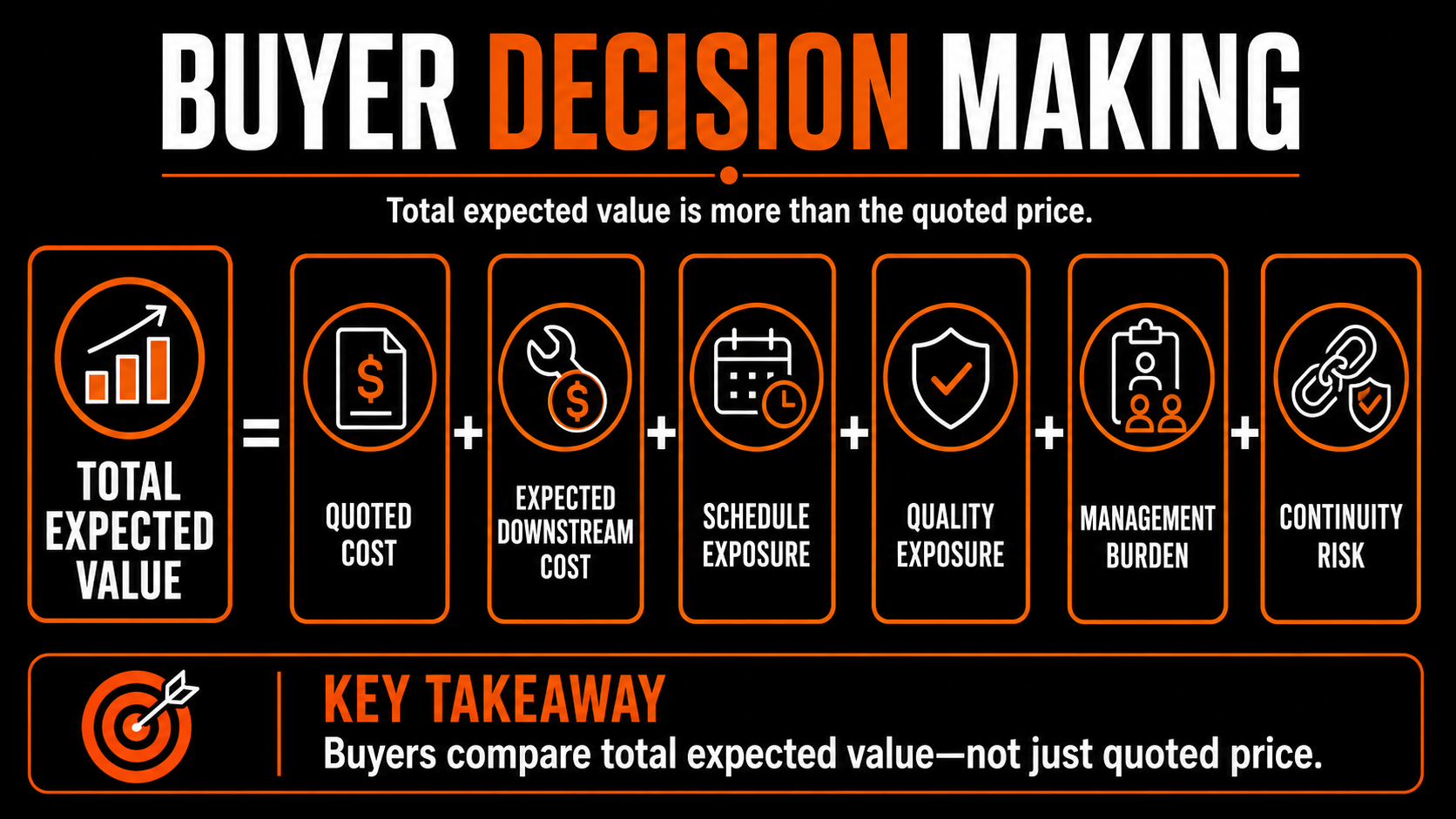
The buyer is therefore comparing more than quoted price.
A practical comparison is:
Total expected value = quoted cost + expected downstream cost + schedule exposure + quality exposure + management burden + continuity risk
The Two Phases of Metalworks Contractor Selection
The 6sense research describes B2B buying as a two-phase journey.
Phase One: Selection
Before speaking directly with sellers, the buying group:
Defines the problem
Develops requirements
Researches possible solutions
Identifies potential suppliers
Evaluates available information
Builds a shortlist
Ranks the shortlisted vendors
Develops a preferred option
In the 2025 study, 94% of buyers said they had ordered their shortlist by preference before engaging sellers. The preferred vendor at the end of this selection phase ultimately won 77% of the time.
Phase Two: Validation
After contact, buyers attempt to confirm or disprove their pre-existing assumptions.
They may validate:
Capacity
Lead time
Pricing
Scope
Technical feasibility
Certifications
Quality systems
Responsiveness
Project approach
Commercial terms
Cultural fit
Risk controls
The first sales conversation is therefore often less of an open audition and more of a verification test.
The Buyer Is Asking, “Is Our Preferred Contractor Really as Good as It Appears?”
The preferred company can still lose.
A contractor may weaken its position by:
Responding slowly
Failing to understand the drawing
Making unsupported promises
Omitting important scope
Providing a confusing quote
Refusing to discuss capacity
Sending outdated certifications
Appearing disorganized
Failing to ask important questions
Creating doubt about follow-through
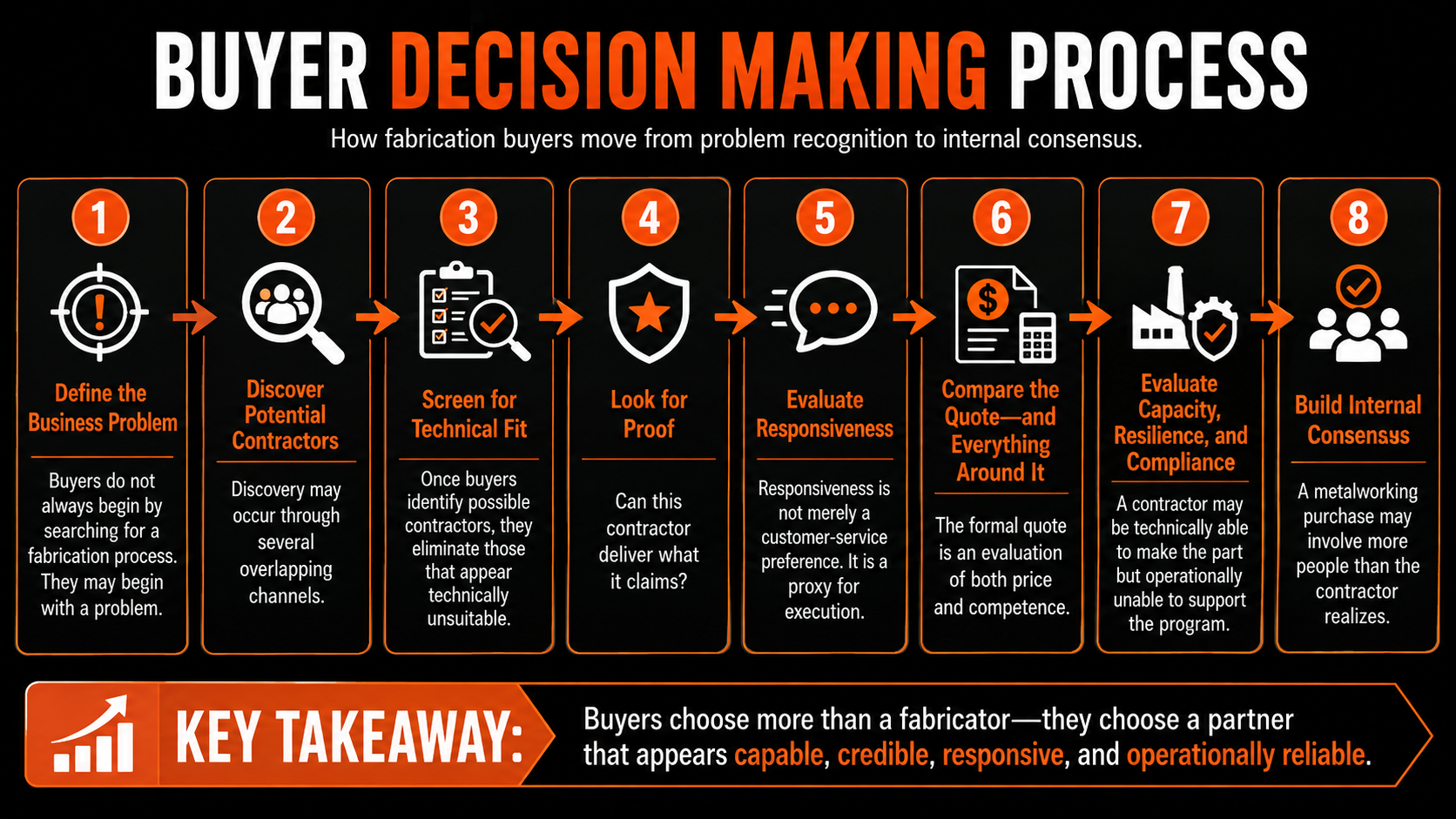
Stage 1: Buyers Define the Business Problem Before Searching
Buyers do not always begin by searching for a fabrication process.
They may begin with a problem:
An incumbent supplier missed delivery.
A product design changed.
A machine needs an obsolete replacement component.
A project requires field welding.
A customer needs greater production volume.
A facility needs custom guarding.
A contractor needs structural steel installed by a fixed date.
A manufacturer wants to consolidate several components.
A purchasing team needs a qualified domestic source.
A quality team needs better traceability.
The Real Requirement May Be Broader Than the Drawing
A drawing may define:
Dimensions
Material
Finish
Tolerance
Weld symbols
Quantity
It may not reveal:
Why the deadline matters
Why the incumbent supplier failed
Which features are most critical
Whether future volume will increase
Which stakeholder is assuming the risk
Whether the part creates a field-installation constraint
Whether a successful first order could become a long-term program
A strong contractor asks enough questions to understand both the technical specification and the surrounding operating problem.
Questions That Signal Commercial Understanding
Useful questions include:
What is driving the required date?
Is this a prototype, replacement, or repeat-production part?
Which dimensions or surfaces are functionally critical?
Does the assembly interact with existing field conditions?
Are there inspection or documentation requirements not shown on the drawing?
Is the quantity expected to change?
Are material substitutions permissible?
Is finishing included?
Who owns freight and installation?
What caused the buyer to seek a new source?
These questions help the contractor quote the actual project rather than an incomplete interpretation of it.
Stage 2: Buyers Discover Potential Contractors
Discovery may occur through several overlapping channels:
Existing supplier relationships
Personal experience
Colleague referrals
Customer recommendations
Google Search
Google Maps
Thomasnet
Trade associations
General contractors
Engineers
Architects
Industry directories
Local business networks
Social platforms
Trade shows
Prior bid lists
Thomasnet describes a network of more than 500,000 suppliers that buyers can filter by certifications, capabilities, services, location, and other criteria. Its supplier-search tools allow buyers to create shortlists and send requests for information directly from search results.
Familiarity Strongly Influences the Shortlist
The 2025 6sense report found that 97% of buyers had personal experience with at least one vendor on the shortlist, while 85% had prior experience with the eventual winner. Buyers had completed an average of eight to nine previous buying journeys in the relevant solution category.
This does not mean unfamiliar contractors cannot win.
It means they must manufacture familiarity before the active opportunity.
They can do that through:
Consistent search visibility
Useful technical content
Directory profiles
Customer case studies
Project photography
Industry participation
Direct relationships
Educational email
Plant visits
Referral networks
Persistent but relevant follow-up
Discovery Is Increasingly Digital
The 2025 BigCommerce Industrial Buyer Report states that more than 60% of surveyed industrial buyers purchased online and that digital channels represented nearly one-third of purchases. The report focuses on industrial distribution and ecommerce rather than custom fabrication, but it demonstrates the broader expectation for speed, accurate information, convenience, and digital self-service in industrial buying.
A custom fabricator does not need an ecommerce checkout to respond to those expectations.
It does need:
Accurate capability information
Current certifications
Real photographs
Clear contacts
Mobile usability
Fast pages
Easy RFQ submission
Drawing uploads
Prompt acknowledgment
Visible service boundaries
Stage 3: Buyers Screen for Technical Fit
Once buyers identify possible contractors, they eliminate those that appear technically unsuitable.
Initial Technical Filters
Depending on the project, buyers may screen for:
Fabrication processes
Welding processes
Materials
Material thickness
Maximum part dimensions
Tolerances
Equipment
Production volume
Field-service ability
Installation coverage
Finishing
Inspection capability
Engineering support
Geographic reach
Industry experience
Required certifications
Thomasnet allows industrial buyers to filter suppliers by quality certifications, ownership classifications, location, product details, capabilities profiles, and validation status. Its Verified Supplier badge indicates that Thomas has reviewed the supplier’s business information, products and services, North American operations, and openness to new quotation opportunities.
Capabilities Must Be Easy to Verify
A buyer should not have to infer that a contractor can perform the work from a photograph or a generic statement such as:
We handle projects of all sizes.
A stronger website specifies:
Processes performed in-house
Processes outsourced
Materials supported
Maximum and minimum dimensions
Equipment capacity
Prototype and production suitability
Inspection methods
Relevant certifications
Industries served
Geographic limitations
Capability Claims Should Include Boundaries
“Precision fabrication” is not a meaningful qualification by itself.
More useful statements include:
Typical tolerance range
Maximum press-brake length and tonnage
Maximum cutting thickness by material
Suitable production-volume range
Available weld processes
Maximum lifting capacity
Available finish specifications
Accepted drawing formats
Field-service radius
The goal is not to publish confidential operational information. It is to reduce uncertainty sufficiently for a qualified buyer to keep the company on the shortlist.
Stage 4: Buyers Look for Proof
Once technical fit is established, the buyer asks:
Can this contractor deliver what it claims?
Evidence Buyers Can Evaluate Before Contact
Useful proof includes:
Relevant case studies
Original project photographs
Certifications
Customer references
Reviews
Inspection equipment
Quality procedures
Equipment photographs
Team biographies
Years of relevant experience
Safety records
Representative project descriptions
Material traceability
On-time-delivery performance
First-pass yield
Documented capacity
Thomasnet advises suppliers to present their company history, value proposition, capabilities, certifications, equipment, production processes, images, PDFs, and videos rather than merely asserting expertise.
Certifications Are Filters, Not the Whole Decision
A required certification may operate as a binary gate.
Without it, the contractor cannot proceed.
With it, the contractor is only one of several qualified options.
A buyer may still ask:
Is the certification current?
What activities and facilities does it cover?
Does the quality system operate consistently?
Can inspection records be provided?
How are nonconformances handled?
What happens when a drawing revision changes?
Are employees trained for the required process?
ASQ defines a quality management system as a formal structure documenting the processes, procedures, and responsibilities used to meet customer and regulatory requirements and improve effectiveness.
The certificate is evidence that a system exists.
The buyer also wants evidence that the system works.
Case Studies Should Help Buyers Compare Risk
A useful fabrication case study should include:
The Customer Situation
What problem or requirement existed?
The Technical Constraint
What made the project difficult?
The Process
Which materials, equipment, methods, and controls were used?
The Result
What changed for the customer?
The Qualification
Under what conditions was that result achieved?
A case study that explains material, process, constraint, inspection, schedule, and outcome gives the buyer more information than a gallery of unexplained finished products.
Stage 5: Buyers Evaluate Responsiveness
Responsiveness is not merely a customer-service preference.
It is a proxy for execution.
The buyer may reasonably assume:
If communication is slow and disorganized before the purchase order, it may be worse after the contractor has the work.
What Buyers Observe During Initial Contact
They notice:
Whether the call is answered
Whether the RFQ is acknowledged
How quickly the contractor responds
Whether a qualified person becomes involved
Whether questions are specific
Whether commitments are documented
Whether files are handled correctly
Whether the next step is clear
Whether stated deadlines are met
CallRail reported in 2025 that an average of 28% of calls in its business-call data went unanswered. The figure is not specific to metal fabrication, but it illustrates the size of the general call-coverage problem.
Fast Does Not Mean Reckless
An immediate acknowledgment is valuable.
An immediate unsupported quote is not.
A good response might say:
We received the drawing package and have assigned it to our estimating team. We will confirm technical fit and identify any missing information by 10:00 a.m. tomorrow.
That communication creates confidence without promising something the contractor has not verified.
A Practical Response Standard
MetalWorks SEO recommends tracking:
Call answer rate
Missed-call recovery rate
Median RFQ acknowledgment time
Median time to technical review
Median time to quote
Percentage of promised response deadlines met
Number of unassigned inquiries
Number of inquiries lost without follow-up
These are implementation recommendations, not universal industry standards.
Stage 6: Buyers Compare the Quote—and Everything Around It
The formal quote is an evaluation of both price and competence.
Buyers Examine More Than the Total
They may compare:
Unit and total price
Material assumptions
Quantity breaks
Lead time
Freight
Tooling
Programming
Setup
Finishing
Installation
Inspection
Packaging
Payment terms
Quote validity
Warranty
Exclusions
Change-order procedures
Ambiguity Creates Perceived Risk
A quote can be inexpensive and still unattractive when the buyer cannot determine:
What is included
What is excluded
Which material grade was assumed
Whether finishing is included
Whether freight is included
Whether installation is included
Which revision was quoted
Whether required inspection is included
Whether the stated lead time begins at order or drawing approval
A clear quote helps the buyer defend the contractor internally.
A vague quote transfers interpretation risk to the buyer.
Total Cost Often Matters More Than Unit Price
The buyer may evaluate:
Total project cost = quoted price + freight + internal labor + inspection + supplier coordination + inventory + rework + delay exposure
A contractor can strengthen its commercial position by explaining:
Which processes are consolidated
Which outside steps are avoided
How the design affects cost
Which quantity creates better economics
Which tolerance or finish drives price
Whether an alternative material is suitable
What the buyer must provide to preserve lead time
Stage 7: Buyers Evaluate Capacity, Resilience, and Compliance
A contractor may be technically able to make the part but operationally unable to support the program.
Capacity Questions
Buyers may ask:
What is the current backlog?
How much capacity is genuinely available?
Is critical equipment redundant?
Is the workforce cross-trained?
Can the contractor support demand increases?
Which processes depend on outside suppliers?
How is preventive maintenance handled?
What happens when key equipment fails?
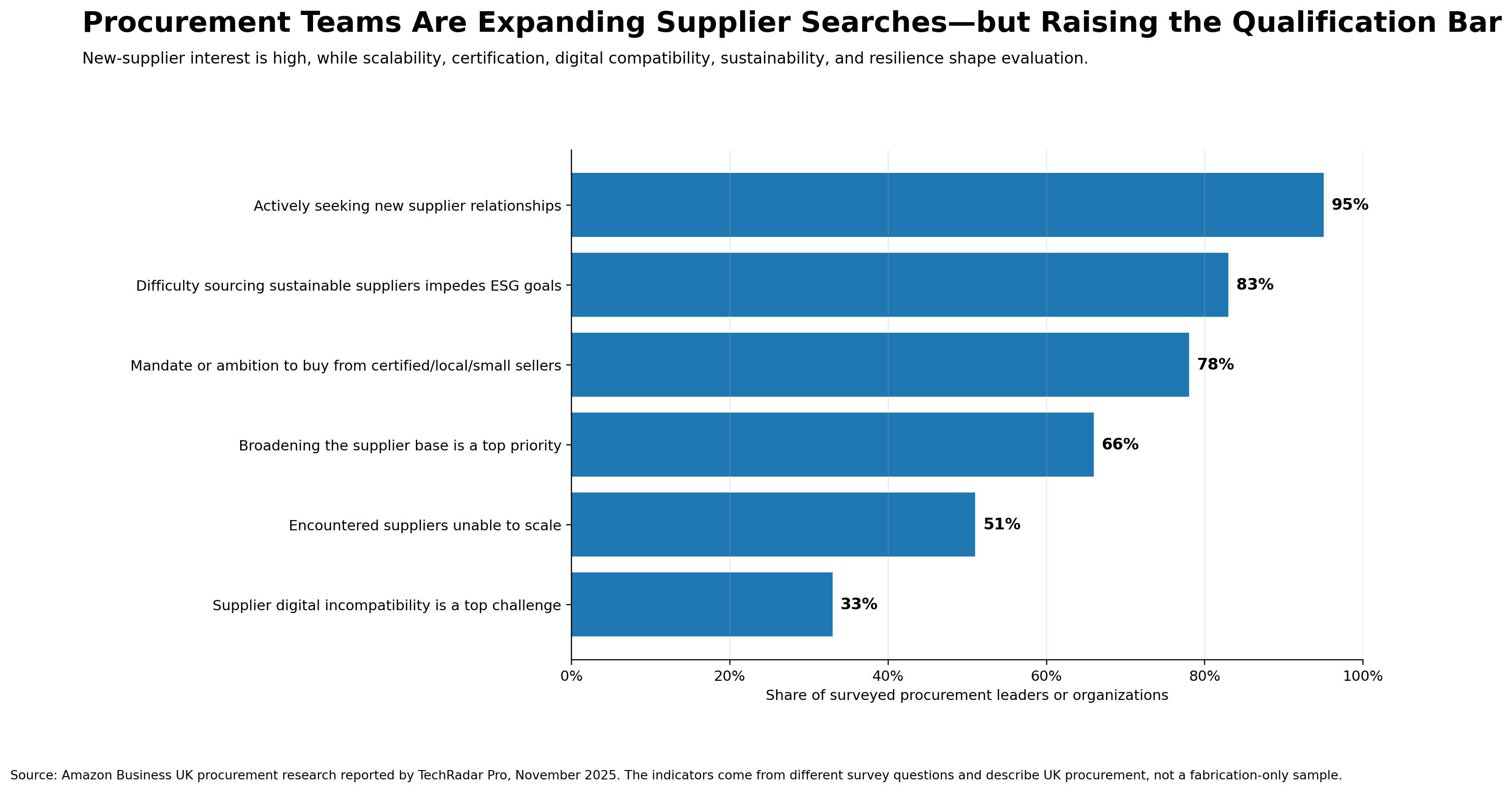
Procurement research reported by TechRadar Pro in late 2025 found that 51% of surveyed UK procurement leaders had encountered suppliers unable to grow with their organizations. The same report said 33% cited supplier digital incompatibility as a significant challenge. These findings are not fabrication-specific, but they highlight why scalability and operating maturity influence supplier choice.
Risk and Compliance Questions
Depending on the work, buyers may review:
Insurance
Safety programs
Quality certification
Welding qualifications
Material traceability
Cybersecurity
Confidentiality
Export controls
Business continuity
Environmental requirements
Supplier diversity
Financial stability
Subcontractor controls
CIPS describes the Kraljic Matrix as a tool for classifying purchasing categories by business importance and supply risk. The more strategically important or difficult to replace the fabricated component is, the more scrutiny the supplier is likely to receive.
A Custom Guard Is Not Evaluated Like a Production-Critical Assembly
The depth of due diligence generally rises with:
Project value
Technical complexity
Safety implications
Replacement difficulty
Production dependence
Regulatory exposure
Customer visibility
Supply concentration
A one-time decorative bracket may be awarded after a simple price and capability check.
A critical welded assembly for a repeat-production program may require audits, samples, inspection records, supplier approval, continuity planning, and several internal stakeholders.
Stage 8: The Buying Group Builds Internal Consensus
A metalworking purchase may involve more people than the contractor realizes.
Engineering
Engineering may evaluate:
Manufacturability
Material
Tolerance
Geometry
Revision control
Process suitability
Technical communication
Procurement
Procurement may evaluate:
Price
Terms
Sourcing policy
Supplier status
Capacity
Commercial clarity
Continuity
Quality
Quality may evaluate:
Certifications
Inspection
Traceability
Calibration
Nonconformance handling
Documentation
Operations or Project Management
Operations may evaluate:
Lead time
Scheduling
Communication
Installation
Logistics
Change management
Finance or Leadership
Leadership may evaluate:
Total cost
Business risk
Strategic fit
Scalability
Supplier concentration
Customer consequences
The 2025 6sense research reported typical B2B buying groups of more than ten participants for purchases averaging approximately $250,000. The exact number will vary substantially by metalworking project, but the broader lesson is important: contractors are often communicating with a group rather than a single decision-maker.
The Best Proposal Helps the Champion Sell Internally
The person speaking with the contractor may need to persuade several colleagues.
Give that champion usable evidence:
A concise capability summary
A clear quote
A relevant case study
Current certifications
Project photographs
A schedule
Assumptions and exclusions
Quality documentation
References
A contact and escalation plan
The easier it is to explain and defend the contractor, the easier it is to approve the contractor.
The Shortlist Is Becoming More Competitive
The average number of vendors evaluated in the 6sense research increased from 4.5 to 5.1 between the prior study period and 2025. Buyers also reported previous experience with more of the companies they evaluated.
Buyers have access to more possible suppliers.
Prior familiarity still strongly influences which suppliers receive serious consideration.
A contractor must therefore be both discoverable and memorable.
The Seven-Gate Metalworks Contractor Selection Scorecard
The MetalWorks SEO model organizes contractor selection into seven gates:
Discovery
Technical fit
Proof and trust
Responsiveness
Commercial fit
Risk and compliance
Relationship confidence
The exact process varies by project. Some gates occur simultaneously, some are abbreviated, and some become formal approval procedures.
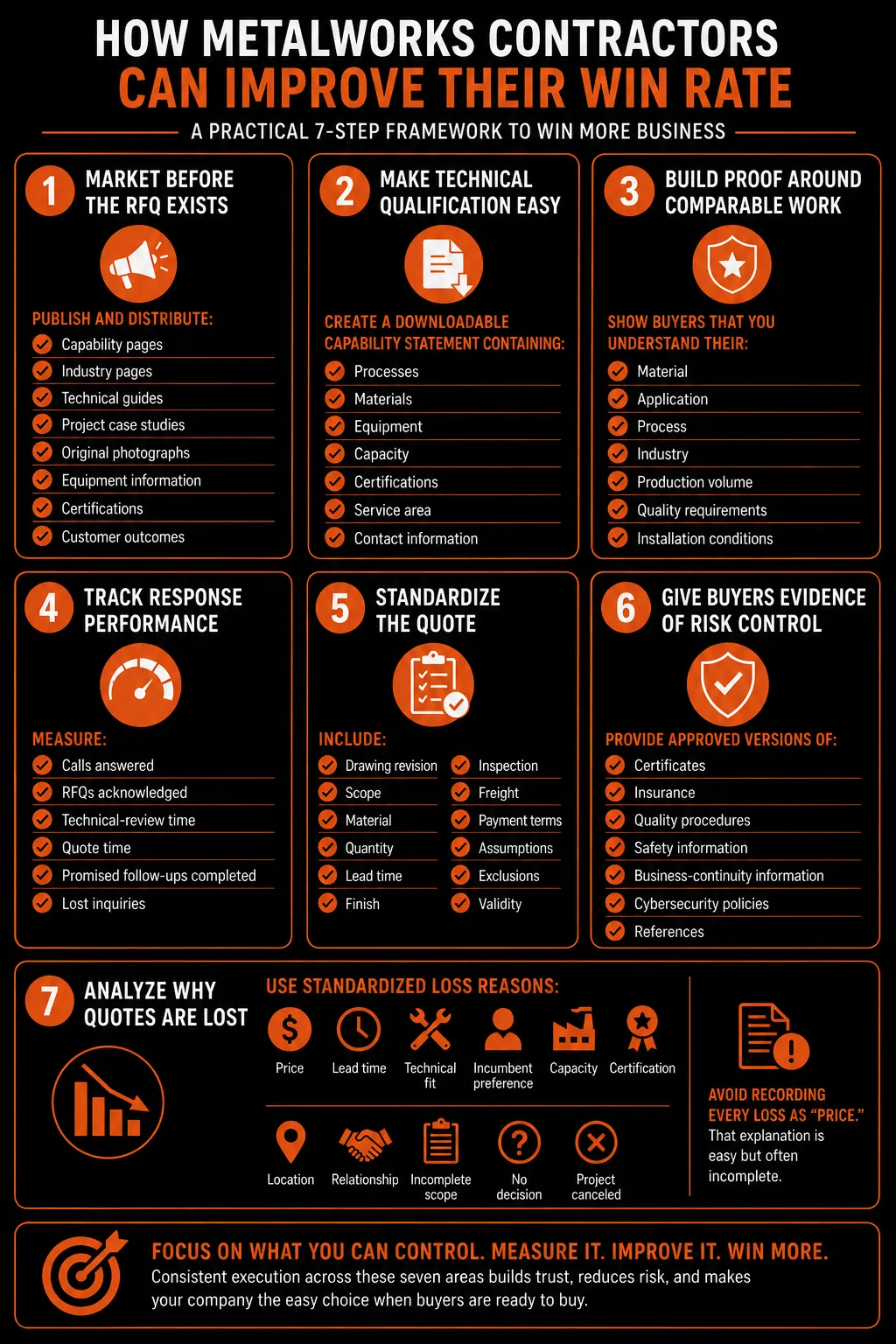
How Metalworks Contractors Can Improve Their Win Rate
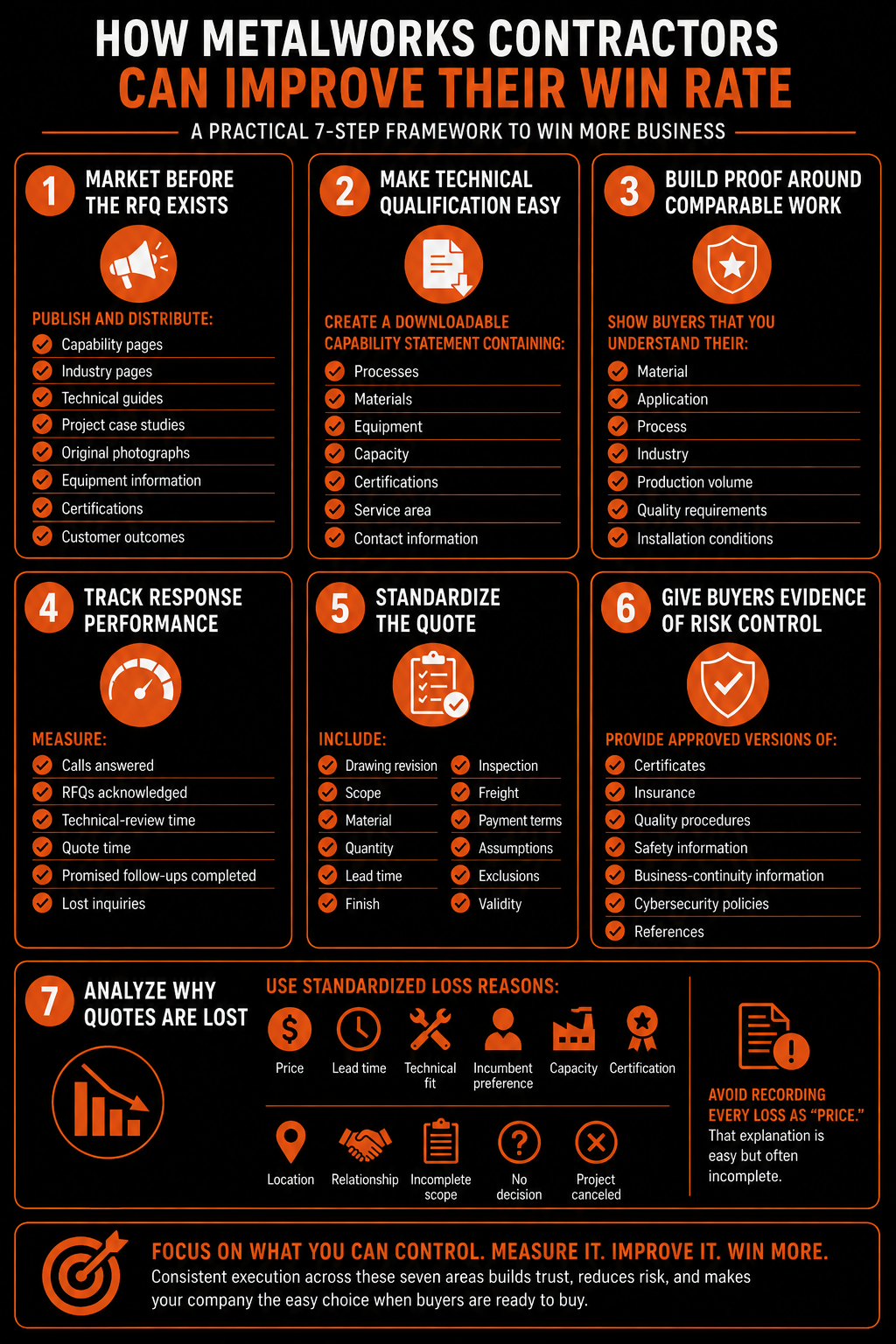
1. Market Before the RFQ Exists
Publish and distribute:
Capability pages
Industry pages
Technical guides
Project case studies
Original photographs
Equipment information
Certifications
Customer outcomes
2. Make Technical Qualification Easy
Create a downloadable capability statement containing:
Processes
Materials
Equipment
Capacity
Certifications
Service area
Contact information
3. Build Proof Around Comparable Work
Show buyers that you understand their:
Material
Application
Process
Industry
Production volume
Quality requirements
Installation conditions
4. Track Response Performance
Measure:
Calls answered
RFQs acknowledged
Technical-review time
Quote time
Promised follow-ups completed
Lost inquiries
5. Standardize the Quote
Include:
Drawing revision
Scope
Material
Quantity
Lead time
Finish
Inspection
Freight
Payment terms
Assumptions
Exclusions
Validity
6. Give Buyers Evidence of Risk Control
Provide approved versions of:
Certificates
Insurance
Quality procedures
Safety information
Business-continuity information
Cybersecurity policies
References
7. Analyze Why Quotes Are Lost
Use standardized loss reasons:
Price
Lead time
Technical fit
Incumbent preference
Capacity
Certification
Location
Relationship
Incomplete scope
No decision
Project canceled
Avoid recording every loss as “price.” That explanation is easy but often incomplete.
Frequently Asked Questions
Do Metalworks Buyers Always Select the Lowest Bid?
No. Price can be decisive when suppliers appear equivalent and the specifications are straightforward. Buyers may accept a higher quote when they believe it provides better quality, shorter or more credible lead time, fewer handoffs, lower risk, stronger support, or lower total cost.
How Many Contractors Does a Buyer Usually Evaluate?
The 2025 6sense study reported an average of 5.1 vendors across its broader B2B sample. The number for a specific metalworks project will vary according to value, complexity, sourcing policy, urgency, and the availability of qualified suppliers.
Are Certifications Enough to Win Industrial Work?
Usually not. A required certification can qualify a contractor for consideration, but buyers may also examine project relevance, quality performance, documentation, capacity, responsiveness, references, and commercial terms.
Do Google Reviews Matter for Metal Fabricators?
They can contribute to discovery and initial trust, particularly for local repair, welding, architectural, installation, and contractor work. For complex OEM or industrial sourcing, technical evidence, references, certifications, prior relationships, and supplier approval procedures may carry more weight.
Why Does the First Vendor Contacted Win So Often?
The evidence suggests the first conversation reflects an existing preference rather than creating it. Buyers usually rank their shortlist first and then contact the favored vendor. In 2025, 94% had ranked the shortlist before seller engagement, and approximately four out of five spoke first with the eventual winner.
What Is the Most Important Factor in Contractor Selection?
There is no universal factor.
The winner must satisfy the project’s combination of:
Technical fit
Quality
Delivery
Price
Risk
Capacity
Compliance
Communication
Relationship confidence
The relative weight changes with the application and the consequences of failure.
Conclusion: Buyers Choose Confidence
Metalworks buyers do not merely choose the company with the largest machine, lowest hourly rate, longest history, or best-looking website.
They choose the contractor they believe can produce the required result without creating unacceptable technical, schedule, commercial, or relationship risk.
That belief forms through a sequence:
1The buyer discovers the contractor.
The contractor survives technical screening.
Its claims are supported by proof.
Its team responds professionally.
Its quote is complete and commercially credible.
Its risks appear controlled.
The buying group reaches sufficient confidence to proceed.
The sales conversation matters.
The quote matters.
But the contractor that wins is often the one that established relevance and trust long before either occurred.
________________________________________
Recommended MetalWorks SEO Call to Action
Are Buyers Finding and Trusting Your Company Before the RFQ?
MetalWorks SEO helps metal fabricators and industrial contractors earn shortlist consideration through:
Technical SEO
Capability-focused website architecture
Buyer-centered content
Case studies and project proof
Industrial directory optimization
RFQ conversion systems
Always-on call coverage
Lead and revenue attribution
Request a Metalworks Buyer-Readiness Audit
The audit can evaluate whether your online presence provides the technical, commercial, and trust evidence buyers need to place your company on the shortlist.
---
Want to know where this is happening in your shop?
We'll run a free growth audit — your site, your local visibility, and how inquiries move from first contact to booked job. Thirty minutes, and the findings are yours either way.
