Why Branding Matters: The Branding Blind Spot for Metal Fab Shops
Key Takeaways
A brand is not merely a logo. It is the collection of expectations, memories, evidence, and experiences buyers associate with a fabrication company.
Metal fab shops often underinvest in branding because referrals, relationships, equipment, and craftsmanship historically generated enough work. That advantage weakens as buyers conduct more independent digital research.
The LinkedIn B2B Institute’s 95–5 framework proposes that roughly 95% of potential B2B buyers are out of market at a given time. Branding helps a shop become memorable before those buyers need a supplier. The ratio is a planning heuristic, not a universal constant for every fabrication category.
In 2025 B2B research, 95% of winning vendors came from the buyer’s Day One shortlist, and buyers had previous experience with most vendors under consideration.
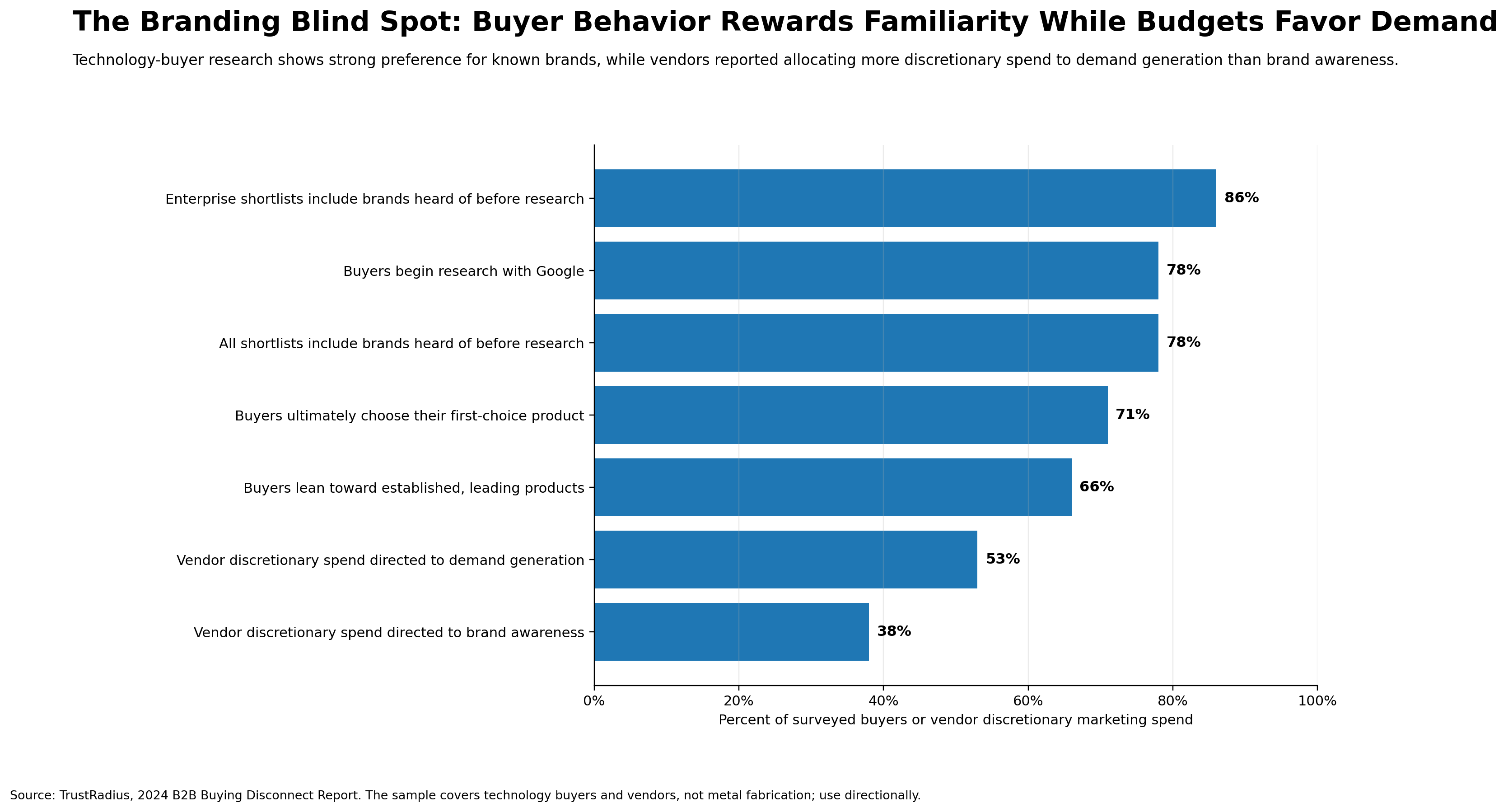
Technology-buyer research found that 78% of buyers creating shortlists included products they had heard of before starting research; among enterprise buyers, that figure reached 86%. The study is not fabrication-specific, but it illustrates the commercial advantage of prior familiarity.
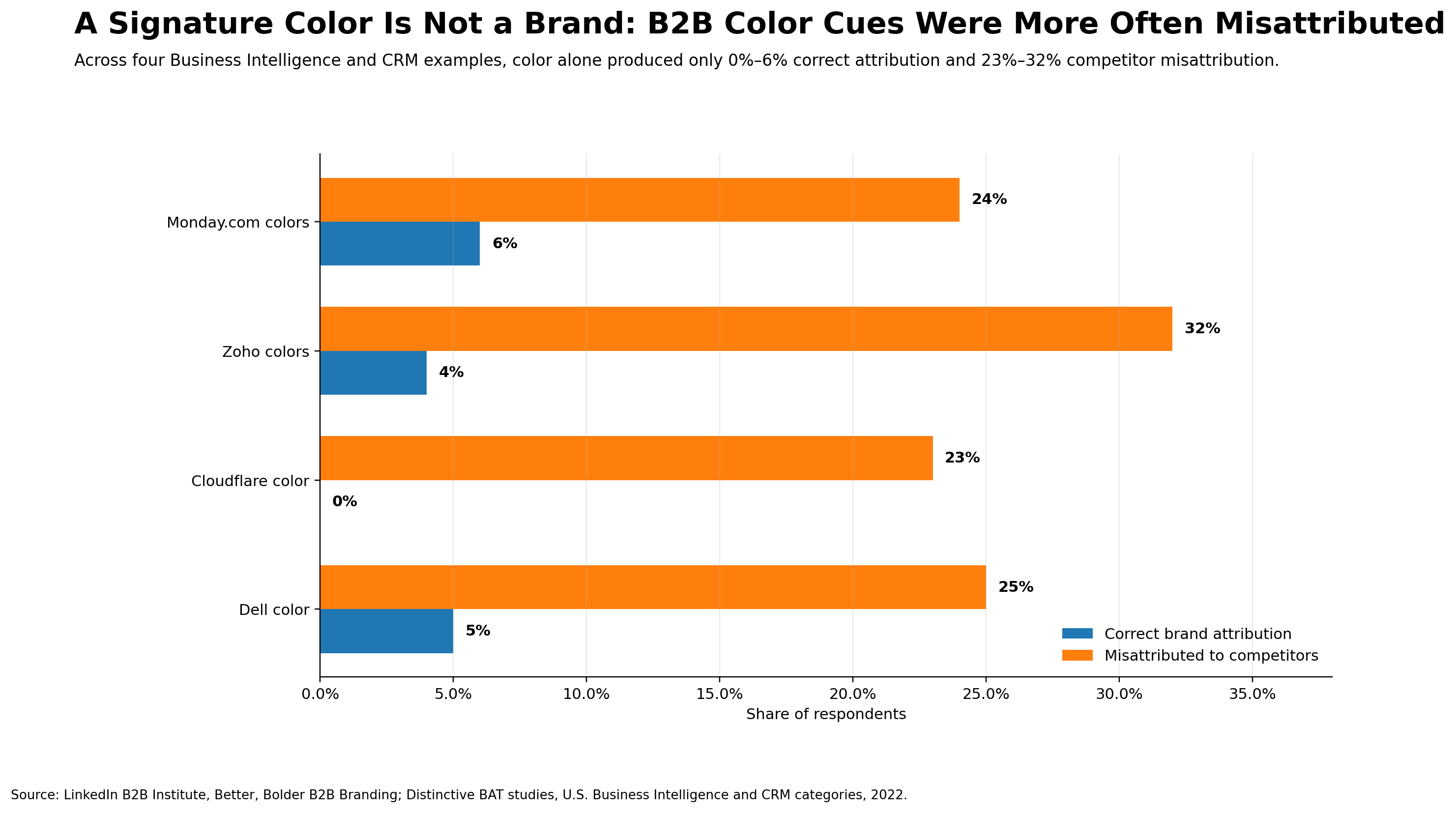
Distinctiveness matters. LinkedIn B2B Institute research found that several common B2B color cues were more likely to be attributed to competitors than to their intended brands.
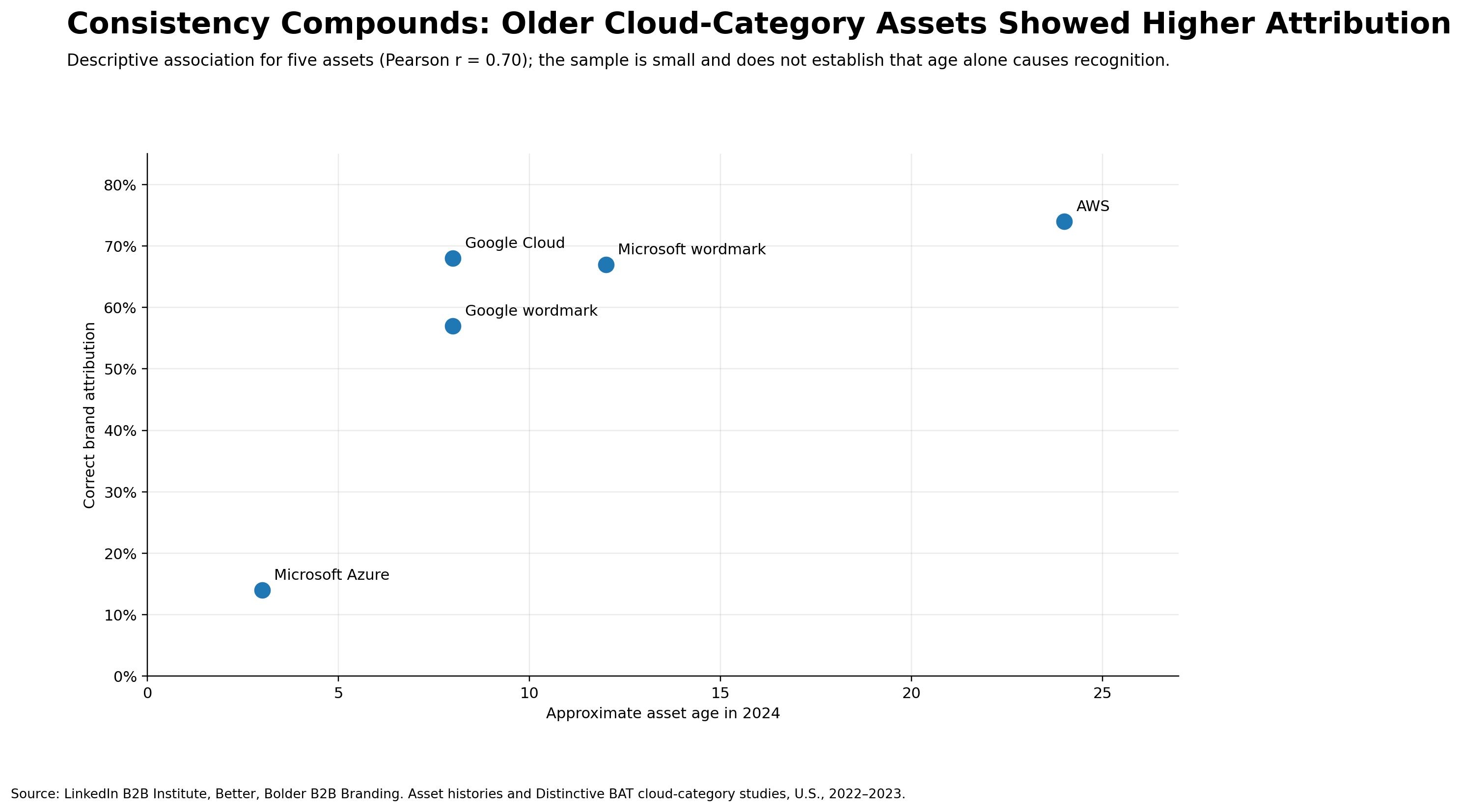
Consistency compounds. Replacing names, logos, messages, colors, and positioning too frequently can destroy memory structures before they become valuable.
A credible fabrication brand requires alignment between positioning, visual identity, project proof, human expertise, customer experience, visibility, and measurement.
Branding can support SEO and buyer trust, but Google does not describe “brand” or E-E-A-T as a single ranking factor. Google emphasizes people-first content, clear authorship, demonstrated experience, accuracy, and trust.
The ultimate test of a fabrication brand is operational: does the customer experience consistently fulfill the expectation the company creates?
A metal fabrication company can own sophisticated equipment, employ exceptional craftspeople, maintain demanding certifications, and deliver reliable work—yet remain almost invisible outside its existing network.
That is the branding blind spot.
Many shop owners think branding means choosing a logo, painting the trucks, ordering embroidered shirts, and making the website look more modern.
Those elements matter, but they are only the visible surface.
A brand is the answer buyers construct when they ask:
What is this company known for, how confident are we that it can deliver, and why should we remember it instead of another qualified shop?
For a metal fab company, branding is a commercial system that influences:
Whether the company is discovered
Whether its name is remembered
Whether it enters the initial shortlist
Whether technical claims appear credible
Whether buyers perceive the shop as interchangeable
Whether a price premium appears justified
Whether a customer refers the company
Whether qualified employees want to join it
Whether the market understands where the shop is strongest
Branding does not replace capability.
It makes capability recognizable, understandable, believable, and memorable.
Why Metal Fab Shops Commonly Underestimate Branding
The Industry Historically Grew Through Relationships
Many fabrication companies were built through:
Word of mouth
Long-standing customer accounts
General-contractor relationships
Local reputation
Personal networks
Repeat production
Sales representatives
Referrals from engineers and suppliers
That model can remain highly valuable.
But it creates a vulnerability: the company may possess strong relationship equity among people who already know it while having almost no mental availability among the next generation of buyers.
Research found that buyers had previous experience with most shortlisted vendors and that 85% had previous experience with the eventual winner. Much of that prior experience came from previous evaluations, not necessarily completed purchases.
A shop does not always need to win the first project to build brand equity.
It needs to make a sufficiently strong impression that it is remembered during the next sourcing event.
“Our Work Speaks for Itself” Is Only Partly True
Excellent work produces:
Repeat business
References
Testimonials
Photographs
Project outcomes
Reputational value
But work can only “speak” to people who encounter the evidence.
A flawless stainless assembly sitting inside a customer’s plant does not automatically educate the wider market about:
Who made it
What problem it solved
Which processes were required
What made the project difficult
How quality was verified
What result the customer achieved
Brand strategy turns private excellence into visible, credible proof.
The Shop Floor Feels More Concrete Than Marketing
Equipment, tooling, software, labor, and material have visible costs and outputs.
Brand investment can feel less certain because its effects may appear through:
More branded searches
Better RFQ quality
Higher direct traffic
Greater response to outreach
More shortlist invitations
Improved quote acceptance
Reduced price sensitivity
More referrals
Stronger recruiting
Higher customer retention
Those outcomes are distributed across the buying journey and are rarely attributed to one campaign.
That makes branding easy to underfund.
TrustRadius reported that surveyed technology vendors directed an average of 53% of discretionary marketing spend toward demand generation and 38% toward brand awareness, even as buyers displayed a strong preference for familiar and established products. The research is technology-specific, but the underlying tension is relevant to industrial firms that invest heavily in immediate leads while neglecting future demand.
Show Image
Branding Begins Before the Buyer Needs a Fabricator
The 95–5 Problem
The LinkedIn B2B Institute’s 95–5 Rule argues that only a small portion of category buyers are actively purchasing at a given moment, while the much larger out-of-market group represents future demand.
The precise proportion will vary for:
Emergency repair
Structural projects
OEM sourcing
Architectural metalwork
Replacement components
Capital equipment
Repeat production
Maintenance fabrication
The strategic principle remains valuable:
A metal fab shop cannot wait until the RFQ appears to begin creating familiarity.
Most prospective customers will not need a new fabricator today.
They may need one after:
A supplier misses delivery
A product design change
New capacity is required
A plant expansion begins
A machine component fails
A construction project is awarded
A quality issue emerges
Reshoring becomes necessary
An incumbent supplier closes
A procurement team adds a second source
Brand building helps the shop become retrievable from memory at that moment.
Buyers Create Shortlists From What They Already Know
In 2025, buyers evaluated approximately five vendors on average, had prior experience with nearly four, and began the journey with approximately four suppliers already shortlisted. Ninety-five percent of winning vendors appeared on that Day One list.
This suggests that the RFQ often arrives after brand influence has already occurred.
The buyer may already have encountered the company through:
A prior quote
A former employer
Google
Thomasnet
LinkedIn
A trade show
A referral
A case study
A truck or field crew
A supplier directory
A local project
A technical article
A plant tour
An industry association
Branding is the system that helps those separate encounters accumulate rather than disappear.
Search Visibility and Brand Visibility Reinforce Each Other
In TrustRadius’s technology-buying study, 78% of buyers reported beginning product research with Google, while 71% ultimately selected the product that had been their first choice after the shortlist was formed.
The sample is not industrial fabrication, but it illustrates a useful distinction:
SEO helps the company appear.
Branding helps the company be recognized, trusted, and remembered after it appears.
A generic result may earn an impression.
A recognizable company with a clear specialty, credible project evidence, and a consistent identity has a better chance of remaining in consideration.
A Brand Is a Risk-Reduction Mechanism
Industrial buyers are not simply selecting a supplier.
They may be exposing their organization to:
Schedule risk
Quality risk
Safety risk
Material risk
Installation risk
Financial risk
Customer risk
Regulatory risk
Supply-continuity risk
A recognizable brand cannot eliminate those risks.
It can make the supplier easier to evaluate.
Familiarity Creates an Initial Confidence Advantage
The LinkedIn B2B Institute reports that a better-known B2B brand may be more likely to be selected even when it is more expensive or perceived as having an inferior product.
This should not be interpreted as permission to offer inferior work.
It shows that buyers do not evaluate technical specifications in isolation.
They also respond to:
Familiarity
Perceived safety
Social proof
Confidence
Ease of justification
Expected support
Reputational consequences
For a purchasing manager, recommending a familiar supplier may feel easier to defend than recommending an unknown shop with similar capabilities.
Brand Makes Technical Proof Easier to Organize
A strong fabrication brand gives buyers a coherent structure for interpreting evidence.
For example:
Brand position: Precision stainless fabrication for regulated production environments.
The company can support that position with:
Stainless project case studies
Relevant certifications
Clean fabrication practices
Material traceability
Inspection procedures
Food-processing or pharmaceutical experience
Team expertise
Documented finishes
Customer references
Without a clear position, the same evidence can appear as an unrelated collection of capabilities.
Brand Can Reduce Perceived Interchangeability
When five shops describe themselves as:
Full service
Quality focused
Customer driven
Family owned
Experienced
Competitively priced
the buyer receives no useful differentiation.
The comparison shifts toward price because the companies have presented themselves as substitutes.
A stronger brand identifies:
The ideal customer
The problems the shop solves best
The work it does not pursue
The operating values that matter
The evidence behind its promise
The experience buyers can expect
The Logo Is Not the Brand
The logo is an identifying asset.
It is not a complete strategy.
A shop can have a modern logo and still suffer from:
Unclear positioning
Generic messaging
Inconsistent photography
Weak project evidence
Unanswered calls
Confusing quotes
Outdated certifications
No recognizable specialty
Inconsistent names across directories
Poor customer communication
Color Alone Is Too Weak
A metal fab company can use blue, gray, black, silver, or orange effectively.
But it should not assume that color alone creates recognition.
A distinctive system may combine:
A recognizable name
A consistent wordmark
A proprietary graphic shape
A specific photographic style
A repeatable layout
An ownable verbal device
A recognizable project-story format
A memorable spokesperson
A consistent motion or video treatment
An identifiable vehicle and uniform system
The assets work together.
A Clever Tagline Is Also Insufficient
The same LinkedIn research found that the average B2B tagline in its dataset was correctly attributed to the intended company only 5% of the time and misattributed to a competitor 15% of the time.
A tagline becomes valuable through repeated association with the company—not because it sounds polished in isolation.
Examples such as:
Built Better
Precision Delivered
Your Partner in Metal
Quality You Can Trust
are easy for competitors to imitate.
A stronger verbal identity may connect to a specific market position:
Complex stainless projects, simplified.
From production constraint to fabricated solution.
One accountable workflow from cut to finished assembly.
Even these statements require sustained use and operational proof.
Consistency Is a Compounding Asset
Branding requires patience.
A company may tire of its identity long before the market has learned it.
Employees see the logo, colors, and message every day.
A prospective buyer may see them twice a year.
Frequent Rebranding Can Reset Memory
The LinkedIn B2B Institute advises companies to resist unnecessary short-term changes and allow distinctive assets to compound through time and consistency.
That does not mean a company should preserve a confusing or strategically damaging identity forever.
A rebrand may be justified when:
The name creates legal or reputational problems
The company has entered a fundamentally different market
The old identity cannot function digitally
Multiple acquisitions require consolidation
The positioning no longer reflects the business
The company is routinely confused with another firm
But many shops do not need a total rebrand.
They need disciplined refinement and consistent execution.
Recognition Is Not the Same as Attribution
A person can recognize an image without connecting it to the correct company.
The cloud-category research showed substantial differences between:
Asset recognition: “I have seen this before.”
Brand attribution: “I know which company it belongs to.”
A fabricator should therefore use distinctive assets alongside its name until the association is strong.
Early-Stage Brand Practice
Use the company name prominently with the asset.
Mature Brand Practice
Once evidence shows strong attribution, selected assets may sometimes work more independently.
Most local and regional metal fab shops should assume they are still in the first stage.
The Seven Layers of a Strong Metal Fab Brand
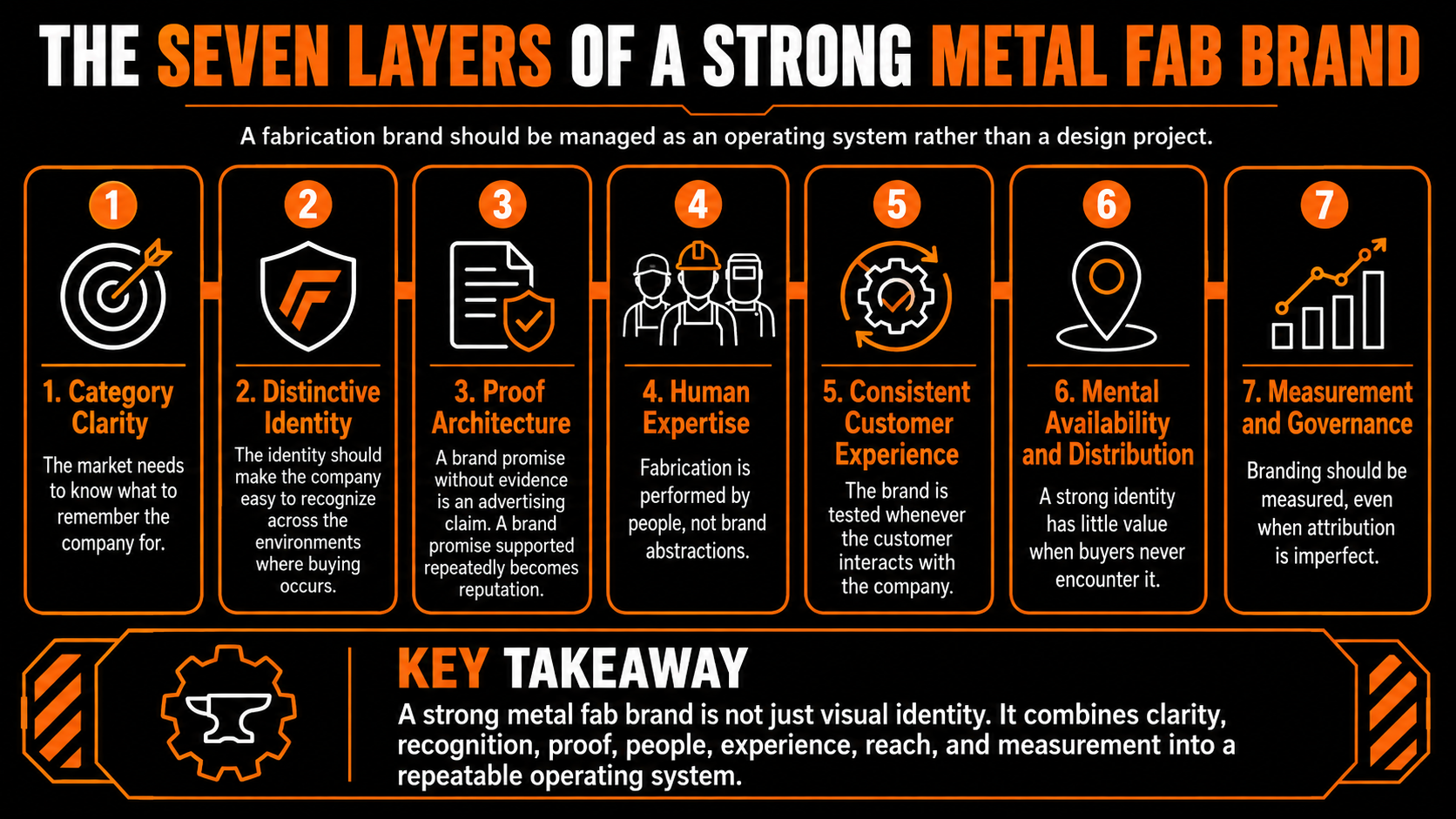
A fabrication brand should be managed as an operating system rather than a design project.
1. Category Clarity
The market needs to know what to remember the company for.
Weak Positioning
We are a full-service metal fabrication company committed to quality.
Stronger Positioning
We fabricate stainless processing equipment and production assemblies for food, beverage, and agricultural manufacturers across the Pacific Northwest.
The stronger statement communicates:
Process category
Material
Project type
Customer
Geography
Define the Brand’s Strategic Center
Ask:
Which work produces the greatest value?
Which customers are the best fit?
Where does the shop possess unusual experience?
Which problems does the team solve repeatedly?
What work creates the best margins?
Which capabilities are genuinely differentiated?
What should the market remember first?
A company can offer many services while building its strongest memory around one or two strategic entry points.
2. Distinctive Identity
The identity should make the company easy to recognize across the environments where buying occurs.
Core Identity Components
Company name
Logo and wordmark
Typography
Color palette
Image treatment
Graphic shapes
Iconography
Tone of voice
Presentation templates
Uniforms
Vehicles
Signage
Social-media templates
Proposal and quote design
Design for Industrial Touchpoints
A brand identity must work:
On a mobile screen
On a hard hat
On a truck
On a shop sign
In a search result
On a capability statement
In a bid package
On a project photograph
In a video
On a fabrication drawing cover sheet
A complicated emblem may look impressive at full size and become illegible on a mobile search result.
The One-Color Test
Can the logo remain recognizable when reproduced:
In black
In white
At one inch
Embroidered
Engraved
Printed on an invoice
Placed over a project photograph
If not, the identity may require simplification.
3. Proof Architecture
A brand promise without evidence is an advertising claim.
A brand promise supported repeatedly becomes reputation.
Organize Proof Into Categories
Technical Proof
Processes
Materials
Tolerances
Equipment
Capacity
Inspection
Certifications
Project Proof
Case studies
Original photographs
Project spotlights
Customer outcomes
Before-and-after examples
Performance Proof
On-time delivery
First-pass yield
Quote turnaround
Rework rate
Safety performance
Customer retention
Human Proof
Team biographies
Qualifications
Years of relevant experience
Employee training
Named experts
Thomasnet advises industrial suppliers to publish their logo, unique company description, value propositions, capabilities, certifications, equipment, production images, PDFs, and videos. It also notes that buyers may be searching for suppliers that meet specific certification requirements.
Make Evidence Easy to Reuse
Create a central proof library containing:
Approved project photographs
Case-study summaries
Customer quotes
Certification files
Quality statistics
Equipment photographs
Team biographies
Video footage
Approved claims
Reference contacts
This prevents each salesperson, estimator, or marketer from rebuilding the story from scratch.
4. Human Expertise
Fabrication is performed by people, not brand abstractions.
Buyers may want to know:
Who reviews the drawings?
Who solves manufacturability problems?
Who owns quality?
Who manages the schedule?
Who answers when something changes?
Who has completed comparable work?
Turn Experience Into Visible Authority
Useful expert-led content may include:
DFM breakdowns
Material-selection guidance
Welding considerations
Distortion-control lessons
Tolerance-cost tradeoffs
Finishing advice
Quoting checklists
Project postmortems
Quality-control explainers
Shop-floor videos
The 2024 Edelman–LinkedIn report found that 73% of surveyed decision-makers considered thought leadership a more trustworthy basis for assessing capabilities and competencies than conventional marketing materials. Eighty-six percent said they would be moderately or very likely to invite a consistent producer of strong thought leadership into an RFP process.
In the 2025 U.S. study, 95% of hidden decision-makers said strong thought leadership made them more receptive to sales or marketing outreach.
These studies focus on broad B2B and professional-service buying rather than metal fabrication. The relevant lesson is that useful expertise can credential a lesser-known supplier before direct contact.
Avoid Generic AI Content
A shop should not publish mass-produced articles that merely rephrase common information.
Google recommends asking:
Who created the content?
How was it created?
Why was it created?
It also emphasizes first-hand experience, clear sourcing, accuracy, substantial value, and people-first purpose.
For fabrication content, that means involving:
Estimators
Welders
Engineers
Operators
Quality managers
Project managers
Customers, as appropriate
5. Consistent Customer Experience
The brand is tested whenever the customer interacts with the company.
Brand Touchpoints Include
Search result
Website
Phone call
Email
RFQ form
Quote
Plant visit
Drawing review
Project kickoff
Status update
Delivery
Invoice
Problem resolution
Follow-up
A company cannot credibly position itself as “the most responsive fabrication partner” while taking three days to acknowledge an RFQ.
It cannot position itself around precision while sending:
Inconsistent documents
Incomplete quotes
Mislabeled files
Outdated certificates
Unclear invoices
Operationalize the Promise
For each brand promise, define a behavior.
Brand promise | Required operating behavior |
|---|---|
Responsive | Calls answered or captured; RFQs acknowledged promptly |
Precise | Revision control, clear scopes, documented inspections |
Easy to work with | Named owner, clear next step, proactive status updates |
Reliable | Credible lead times and measured on-time delivery |
Innovative | Visible DFM process and evidence of successful improvement |
Turnkey | One accountable workflow with clearly defined inclusions |
Branding becomes credible when the behavior is repeatable.
6. Mental Availability and Distribution
A strong identity has little value when buyers never encounter it.
Build Presence Where Sourcing Occurs
Google Search
Google Business Profile
Thomasnet
Industry directories
LinkedIn
YouTube
Email
Trade shows
Local business networks
Customer referrals
General-contractor networks
Engineering relationships
Supplier partnerships
Thomas allows industrial buyers to filter suppliers by location, company type, capabilities, certifications, validation status, and other structured criteria. Buyers can then shortlist suppliers and send RFIs from the platform.
Brand consistency across those locations helps buyers confirm that they have found the same company.
Balance Brand Building and Lead Activation
The LinkedIn B2B Institute recommends balancing longer-term brand building and short-term activation, citing a 50/50 starting point from its analysis of B2B cases. It also reports that campaigns designed to increase mental availability and fame tend to produce stronger long-term business effects.
A small fabrication shop does not need to divide every dollar mechanically in half.
It should avoid spending the entire budget on people who are ready to request a quote today.
A balanced program may include:
Short-Term Activation
Google Search advertising
RFQ landing pages
Retargeting
Call capture
Outbound campaigns
Quote follow-up
Long-Term Brand Building
Case studies
Technical articles
Project video
Community visibility
Industry education
Customer stories
Consistent social presence
Branded search investment
7. Measurement and Governance
Branding should be measured, even when attribution is imperfect.
Awareness Metrics
Branded search impressions
Branded search volume
Direct website traffic
Google Business Profile discovery
Social reach among target industries
Directory profile views
Unaided awareness interviews
Consideration Metrics
Shortlist invitations
Repeat website visitors
Case-study engagement
Capability-statement downloads
Return visits from target accounts
RFI and RFQ quality
Commercial Metrics
Qualified RFQs
Quote-to-win rate
Average project value
Gross margin
Pricing realization
Sales-cycle length
Repeat revenue
Referral revenue
Consistency Metrics
Correct logo usage
Message consistency
Directory accuracy
Document-template adoption
Project-photo quality
Brand-asset compliance
Brand-to-Revenue Analysis
Ask every qualified opportunity:
How did you first hear about us?
Had you heard of us before this project?
Which materials influenced your decision?
Were we on the initial shortlist?
Why did you contact us?
Why did we win or lose?
This will not create perfect attribution.
It will produce better evidence than assuming every opportunity came from its final click.
How Branding Supports SEO Without Becoming an SEO Myth
Branding can improve the quality and consistency of a company’s search presence.
That does not mean Google provides a universal “brand score” that directly determines rankings.
Use One Consistent Company Identity
Google advises websites to use a unique, accurate, concise site name consistently across the homepage and structured data.
Review consistency across:
Legal name
Public-facing brand
Website
Google Business Profile
Thomasnet
Social accounts
Directories
Press mentions
Add Accurate Organization Data
Google states that Organization structured data can help its systems understand and disambiguate an organization. Relevant properties can include its name, logo, address, contact details, and identifiers.
This does not guarantee a particular search appearance or ranking.
It helps create cleaner entity information.
Use Article Markup Where Appropriate
Google supports Article and Blog Posting structured data to help it understand article titles, images, authorship, and publication information.
Structured data should match the visible page and should never include fabricated credentials, reviews, or dates.
A 90-Day Metal Fab Brand Improvement Plan
Days 1–30: Diagnose the Current Brand
Conduct Customer Interviews
Interview:
Best customers
former customers
Lost prospects
Employees
Suppliers
Salespeople
Estimators
Ask:
What are we known for?
Why did you first contact us?
What did you initially assume about us?
Why did you trust us?
Where did we create friction?
Who do you consider our alternatives?
What work would you never think to call us for?
Audit the Market
Review ten to twenty competitors for:
Positioning
Visual identity
Service claims
Project proof
Photography
Content
Reviews
Search visibility
Calls to action
Identify the category clichés everyone shares.
Audit Brand Consistency
Review:
Website
Google Business Profile
Thomasnet
LinkedIn
Proposals
Quote templates
Email signatures
Vehicles
Signage
Uniforms
Capability statements
Days 31–60: Define and Build
Choose the Strategic Position
Define:
Ideal customer
Priority work
Distinctive expertise
Customer outcome
Proof
Geographic market
Refine the Identity System
Build or document:
Logo versions
Spacing rules
Color specifications
Typography
Photography standards
Graphic elements
Tone of voice
Document templates
Build the Proof Library
Collect:
Ten strong projects
Twenty original photographs
Current certifications
Five customer testimonials
Three case studies
Team biographies
Equipment data
Quality and delivery metrics
Days 61–90: Deploy and Measure
Update Priority Touchpoints
Start with:
Homepage
Capability pages
Google Business Profile
Thomasnet profile
Capability statement
Quote template
Email signatures
LinkedIn company page
Publish Expert Content
Create:
One flagship technical article
One case study
One project video
Four short expert posts
One downloadable buyer resource
Establish Baseline Metrics
Record:
Branded search impressions
Direct traffic
Qualified RFQs
Call answer rate
Quote win rate
Average project value
Referral share
Current directory impressions
The Metal Fab Branding Blind-Spot Audit
Positioning
A buyer can explain what the company is known for.
Priority customers and projects are clear.
The message is meaningfully different from competitors.
Claims are supported by evidence.
Identity
The logo works at small sizes and in one color.
Typography and imagery are consistent.
The brand is recognizable without relying only on color.
Vehicles, documents, uniforms, and digital channels align.
Proof
The website uses original project photography.
Case studies explain material, process, constraint, and result.
Certifications are current.
Team expertise is visible.
Performance claims can be substantiated.
Experience
Calls are answered or captured.
RFQs receive prompt acknowledgment.
Quotes are clear and consistently formatted.
Customer updates follow a defined process.
The operational experience fulfills the brand promise.
Visibility
The company appears for priority capability searches.
Business information is consistent across platforms.
The Thomasnet or supplier-directory profile is complete.
Technical content is published consistently.
Brand and demand programs are both funded.
Measurement
Branded search is tracked.
Qualified RFQs are attributed.
Win-loss reasons are documented.
New customers are asked how they first became aware of the shop.
Brand consistency is audited periodically.
Common Metal Fab Branding Mistakes
Mistake 1: Making the Brand About the Equipment
Equipment supports the promise.
It is not the complete customer value proposition.
Mistake 2: Copying the Industrial Category
A logo that looks exactly like every welding or fabrication logo may signal category membership without creating memory.
Mistake 3: Rebranding Without Repositioning
Changing colors while retaining an unclear market position produces a newer-looking version of the same problem.
Mistake 4: Claiming Quality Without Proof
“Quality” should be demonstrated through processes, measurements, certifications, photographs, and customer evidence.
Mistake 5: Hiding the People
Experienced buyers want to know who will review, build, inspect, communicate, and solve problems.
Mistake 6: Treating Marketing as a One-Time Project
Brand memory requires sustained exposure.
A six-week burst followed by eighteen months of silence rarely creates durable familiarity.
Mistake 7: Allowing Operations to Contradict the Message
No identity system can compensate indefinitely for:
Missed deadlines
unanswered calls
unclear quotes
inconsistent quality
poor communication
Frequently Asked Questions
Does a Small Metal Fab Shop Really Need a Brand Strategy?
Yes, although the strategy does not need to be elaborate.
A small shop still benefits from clearly defining:
What it wants to be known for
Who it serves best
Which work it prioritizes
Why buyers trust it
How it looks and communicates consistently
Is Branding More Important Than Equipment or Certifications?
No.
Branding cannot replace technical qualification.
It helps buyers discover, understand, remember, and trust the technical qualification the company already possesses.
How Much Should a Fabricator Spend on Branding?
There is no universal percentage.
The budget should reflect:
Growth goals
current awareness
geographic market
customer concentration
sales-cycle length
competitive intensity
available proof
lifetime customer value
The important principle is not to direct the entire budget toward immediate lead capture while ignoring future buyers.
Should a Fabrication Company Rebrand?
A rebrand may be appropriate when the current identity is misleading, unusable, legally problematic, or disconnected from the company’s direction.
A company should not rebrand merely because internal stakeholders are bored with familiar assets.
Can Branding Help a Fabricator Charge More?
Branding does not automatically justify higher pricing.
It can support pricing power when it credibly communicates:
Lower risk
specialized expertise
stronger quality
better responsiveness
greater convenience
more predictable delivery
superior project outcomes
The price must still be supported by delivered value.
Is Brand Awareness a Google Ranking Factor?
Google does not describe brand awareness or E-E-A-T as one specific ranking factor. Its systems use many signals, and Google emphasizes helpfulness, experience, expertise, authority, and—most importantly—trust.
Is Thought Leadership Relevant to a Local Fabrication Shop?
Yes.
Thought leadership can be practical and local:
How to prepare drawings for a quote
Common causes of welded-frame distortion
When to use stainless instead of coated carbon steel
What affects press-brake forming cost
How to plan for field installation
Questions to ask a fabrication supplier
The content should reflect actual experience rather than generic commentary.
Conclusion: The Market Cannot Value What It Cannot Remember
Metal fab shops often assume that technical capability creates its own demand.
It does not.
Capability must be:
Discovered
understood
differentiated
verified
remembered
experienced consistently
Branding is the system that makes this possible.
The logo matters.
The colors matter.
The website matters.
But the real brand is larger:
It is the promise buyers remember, the evidence they trust, and the experience they expect when your company’s name appears on the shortlist.
A strong metal fab brand does not make an average shop look exceptional.
It makes an exceptional shop easier to recognize—and harder to replace.
Recommended MetalWorks SEO Call to Action
Is Your Shop Better Than Your Brand Makes It Look?
MetalWorks SEO helps fabrication companies translate shop-floor capability into a recognizable and commercially credible market position through:
Industrial brand strategy
Technical SEO
Website positioning
Capability and industry pages
Project case studies
Expert-led content
Supplier-profile optimization
RFQ conversion systems
Call capture
Brand-to-revenue measurement
Request a Metal Fab Brand and Visibility Audit
The audit can evaluate your positioning, differentiation, visual consistency, project proof, search visibility, supplier profiles, buyer trust signals, and RFQ experience.
---
Want to know where this is happening in your shop?
We'll run a free growth audit — your site, your local visibility, and how inquiries move from first contact to booked job. Thirty minutes, and the findings are yours either way.
